The content writing industry is among the most affected due to the advent of generative AI. When ChatGPT started making waves as a Chatbot that can write articles, edit paragraphs, and follow writing instructions the same as human writers do, it was a ‘watershed moment’ for the content writing industry. Generative AI has severely impacted the content writing industry, and who can share the experience better than the content writing firms themselves?
In 2026, we surveyed 1165 content writing firms, freelance content writers, and content outsourcing companies from India, the USA, the UAE, the UK, Australia, Germany, and other countries to understand how generative AI has impacted their content writing process, content writers, revenues, client expectations, client onboardings, client retention, and overall profitability.
The advent of generative AI represents the most disruptive technological shift the content writing industry has faced in its history. The rise in content marketing, SEO, video marketing, and social media also impacted the content writing services world, but generative AI’s impact is more consequential. It is reflected in our research findings.
Generative AI has created both significant disruption and, in some limited cases, new opportunities. It has accelerated output while raising serious questions about quality, originality, and the integrity of human writers. On the client side, it has introduced unprecedented scrutiny and skepticism; on the revenue side, it has exerted downward pressure on pricing. Content writing firms are now forced to invest in new AI tools, such as AI content detectors for verification processes.
This research article is based on the survey results that we obtained.
Survey Methodology
The survey was conducted between March 22, 2026, and March 31, 2026. Respondents were selected through a combination of our industry network, content writing associations on LinkedIn, our own 8000+ connections on LinkedIn, and direct outreach to content agencies. Participation was voluntary, and responses were anonymized to encourage candid disclosure.
Respondent Profile
The 1165 survey participants comprised three primary segments:
-
- Content Writing Agencies (full-service firms managing multiple writers and client accounts): 32 respondents.
- Freelance Content Writers (independent professionals writing across niches): 1040 respondents.
- Other Content Writers: Writers who work in-house at any company in diverse segments (IT, Digital marketing, Logistics, etc.): 93 respondents
Geographic Distribution
Respondents were drawn from 22 countries, with the largest concentrations from India (34%), the USA (22%), the UK (14%), the UAE (9%), and Australia (7%). The remaining 14% were distributed across Germany, Canada, the Philippines, South Africa, Singapore, and 9 other countries.
Key Findings
- 88% of content writing industry respondents now use AI writing tools.
- 63% of surveyed writers report spending more time editing AI output than original writing.
- 44% report an increased incidence of duplicate or near-duplicate content due to AI.
- 69% of survey participants reported a noticeable decline in average content quality.
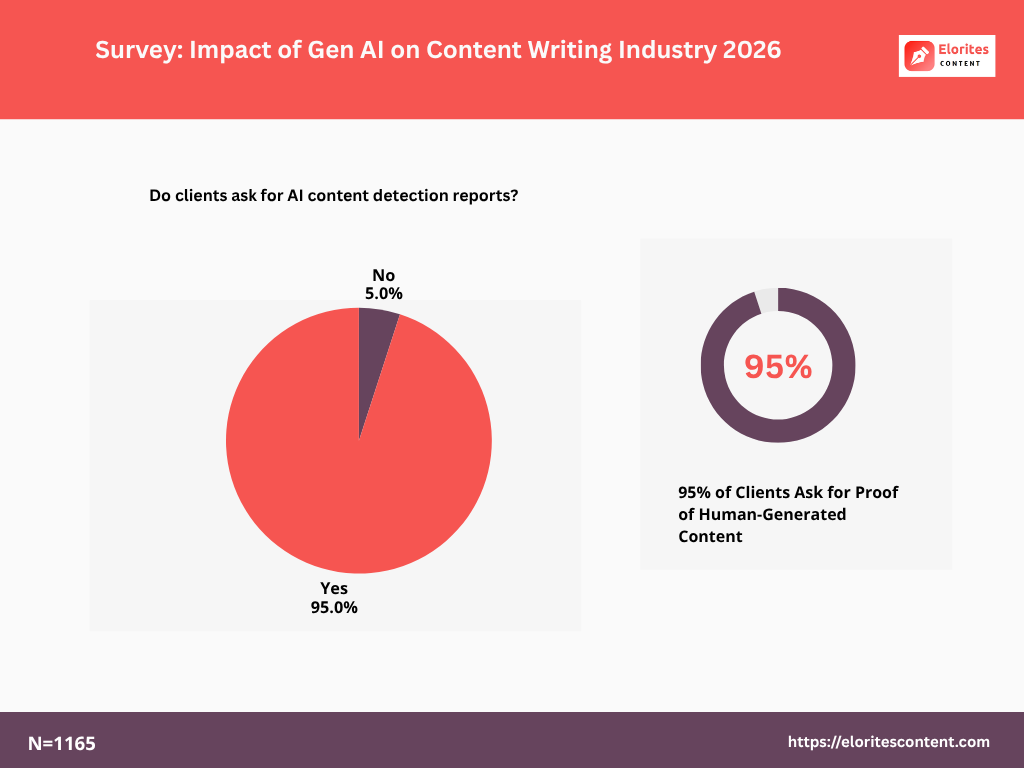
- 95% of clients now ask for proof of human-generated content.
- 85% of firms and freelancers have faced a “blame game” regarding AI use for poor-performing content.
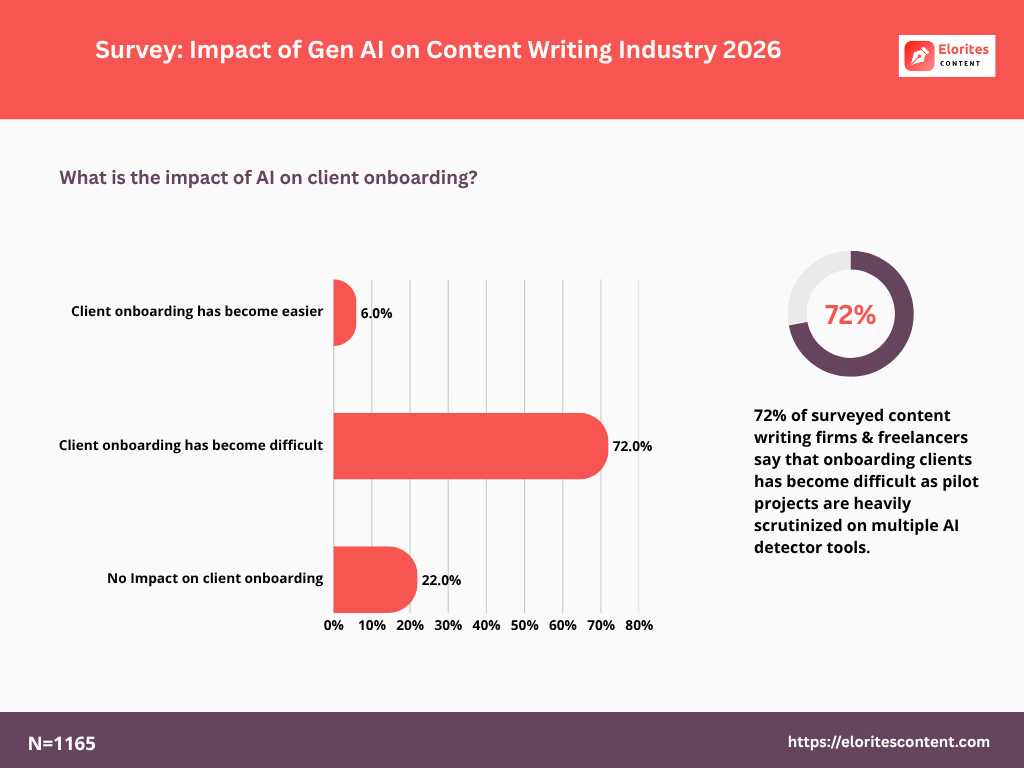
- 72% of respondents say onboarding clients has become difficult due to heavy scrutiny via AI detectors.
- 45% revealed that clients are not willing to pay as much as they did in pre-AI times.
- 52% of content writing firms report a decline in annual revenue directly attributable to AI.
- 38% of firms reported an increase in operational costs due to AI detection software subscriptions.
- 29% of agencies and freelancers have repositioned themselves as “AI-Free” or premium human content providers.
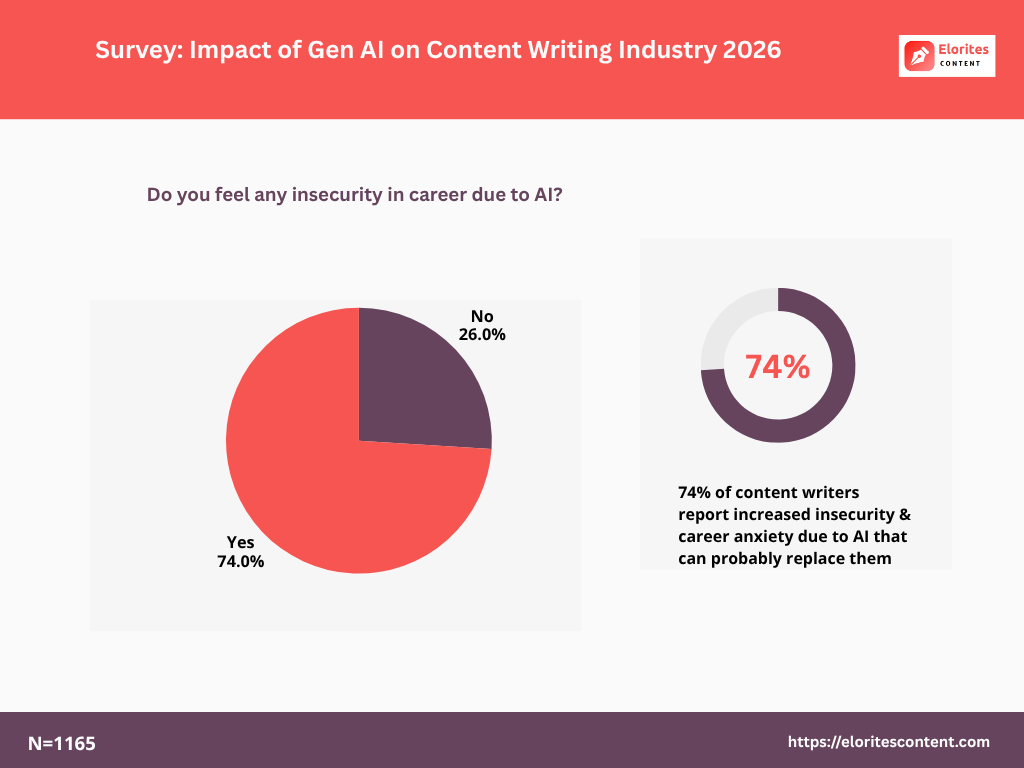
- 74% of content writers report increased insecurity and career anxiety due to AI.
- 56% of freelance writers reported a decline in work opportunities.
- 19% of writers are considering or are open to exiting the content writing industry.
- 24% of surveyed content writers stated they are resilient towards Gen AI.
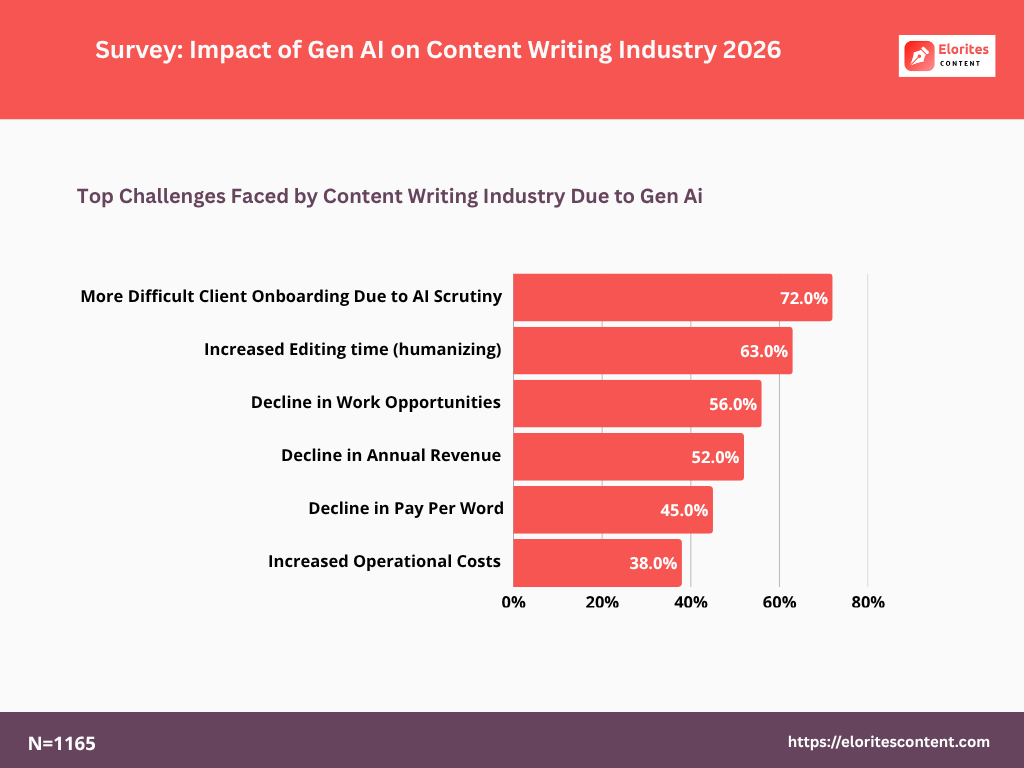
Top challenges faced by content writing industry include:
- More difficult client onboarding due to AI scrutiny.
- Increased editing time to humanize content.
- Decline in work opportunities.
- Decline in annual revenue.
- Decline in pay per word.
- Increase in operational costs.
5 Key Areas Where Gen AI Impacts the Content Writing Industry
#1 Writing Process
Generative AI has changed how writers plan, draft, edit, and finalize content. The survey reveals a complex picture: AI has made certain tasks faster and more efficient, but it has also introduced new quality control burdens, humanizing efforts, and ethical dilemmas that did not previously exist.
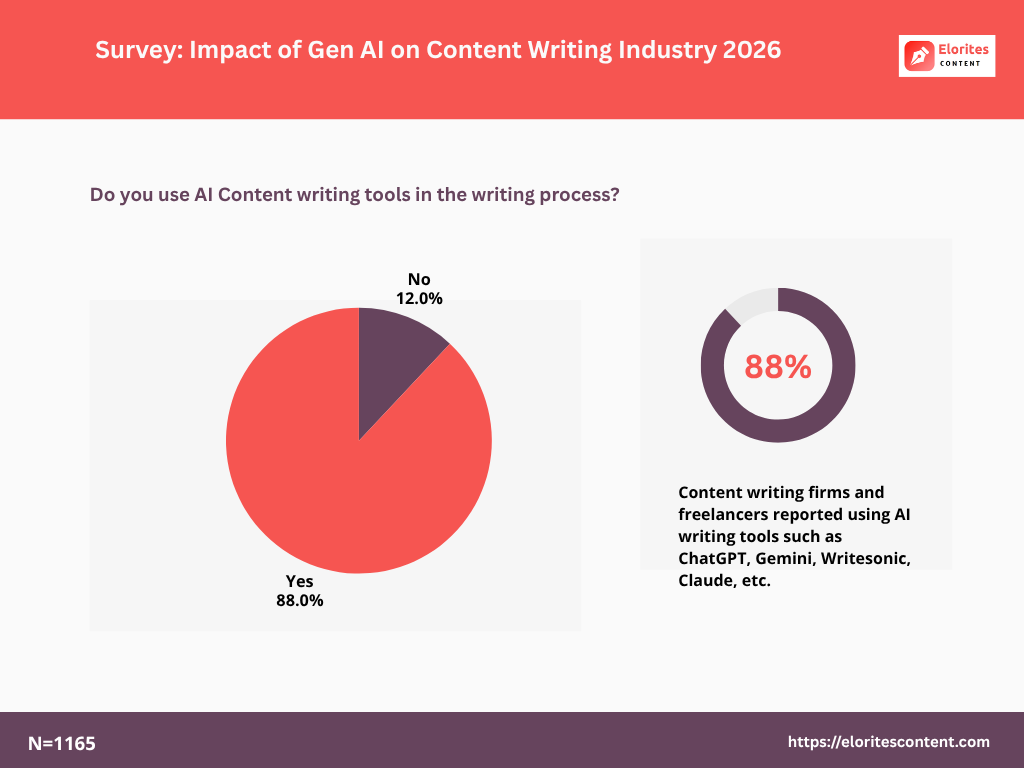
88% of Content Writing Industry respondents stated that they now use AI writing tools (ChatGPT, Gemini, Writesonic, Claude, etc.).
Importantly, most respondents emphasized that their use of AI is supplementary only. They use AI for basic guidance, content draft creation, research, adding points, table creation, and other content workflows. However, a large part of the AI is refined solely by human writers.
| Nikhil Bhandari, Founder of The AI Shakti company reveals that they are using AI-powered content workflows to deliver growth-focused content marketing solutions. |
However, a concerning minority of respondents (particularly small-scale freelancers) admitted to submitting lightly edited AI output to clients without full disclosure.
63% of surveyed writers reported spending more time editing AI output than original writing
One of the most counterintuitive findings of this survey is that, despite AI tools promising to speed up content creation, nearly two-thirds of writing professionals reported spending more time on verification, editing, correction, fact-checking, and humanizing AI-generated content than on writing content from scratch.
While content writers use AI to accelerate their work, create first drafts, and meet demanding deadlines, the post-draft edit is highly time-consuming. The result is an ironic productivity paradox: AI accelerates the first-draft stage but creates a more demanding, time-consuming post-draft stage.
44% report increased incidence of duplicate or near-duplicate content due to AI
Since the proliferation of AI writing tools, nearly half of the survey participants have observed a marked increase in duplicate or near-duplicate content churned out by these tools. Identical sentences, ideas, headings, and similar data points create originality issues. This is a serious concern for SEO-focused content clients, as search engines penalize duplicate content.
| Because AI models are trained on similar datasets, they frequently generate structurally identical responses to similar prompts. When multiple writers or agencies use the same AI tools with similar inputs, the resulting content can be nearly indistinguishable. |
#2 Content Output & Quality
The impact of generative AI on the volume of content output is profound. and paradoxical. While AI has dramatically increased the quantity of content that can be produced, Many industry participants report that average content quality has declined, and they often face Google Indexing issues.
Content volume output has increased 1.5x on average for firms using AI Tools
Among firms that have actively integrated AI into their content production workflows, the average reported increase in content volume was 1.5 times their pre-AI output. This means that AI writing tools have increased content output. Emails, product descriptions, meta descriptions, title generation, and social media content are now mostly created via AI.
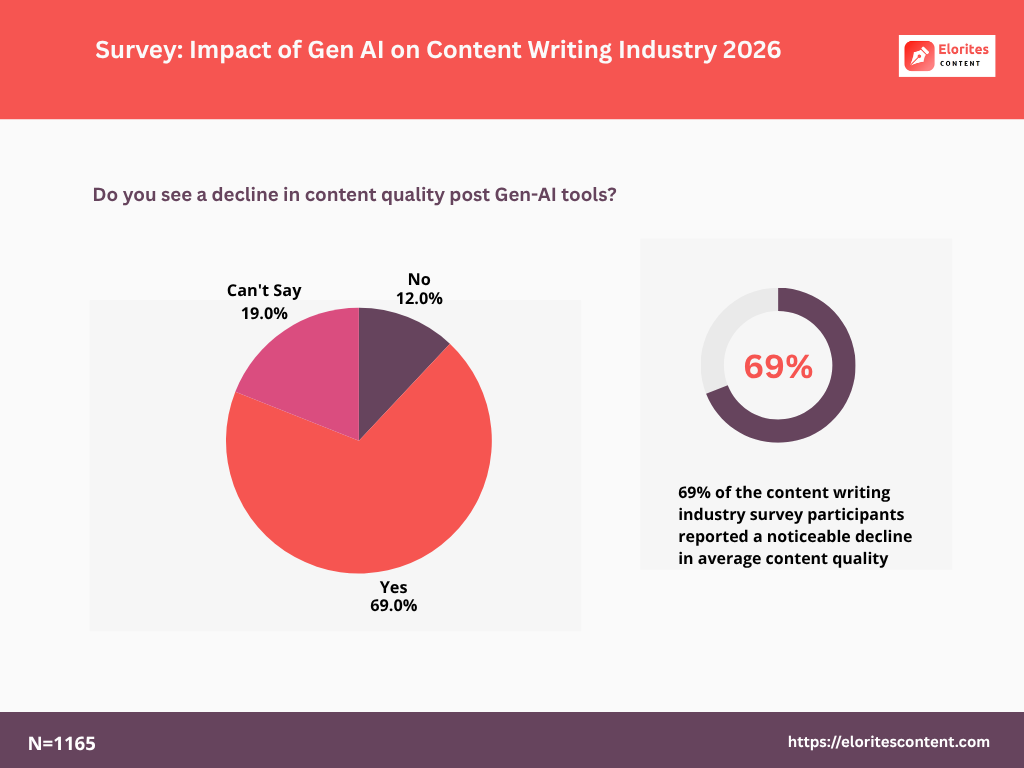
69% of the content writing industry survey participants reported a noticeable decline in average content quality
Despite the surge in volume, nearly seven in ten survey respondents believe the overall quality of content in the market has declined meaningfully since AI writing tools became mainstream. AI tools have given rise to generic content, paraphrased content, and content that lacks real expertise. Interestingly, many content writing experts view this decline in quality as a double-edged sword.
| Vani Shah, the founder of Riterspire Content Writing Services, says that “Content quality issues with AI-generated content extend an opportunity for premium content writing firms that deliver expert-authored content written by industry experts.” |
| “Many clients who have experimented with AI-generated content in-house, citing disappointment with its quality, have come to us for human-generated content”, says Varsha Jain, Director at Elorites Content. |
#3 Clients
The impact of AI on the client side of the content writing industry is largely negative. Clients have become more demanding, more skeptical, and less willing to pay premium rates as suspicion has risen that writers are using AI. The client relationship, once built largely on trust and writing quality, now involves a new layer of AI scrutiny that has fundamentally altered the dynamics of client acquisition, onboarding, and retention.
95% of Clients Ask for Proof of Human-Generated Content
The biggest challenge freelance writers and content writing agencies face is that clients are now demanding AI content detector reports. Earlier, this was not the case. Clients only used to judge the content for relevance, quality, industry-specific terminology, grammar integrity, originality (plagiarism), and language standards.
Now, AI has become the foremost factor for them. In our research, content agencies reported that almost 95% of their clients ask for AI reports or scrutinize AI.
Client scrutiny creates an entirely new operational cost burden for content writing firms. They must now subscribe to and regularly run their content through AI detection tools.
85% of Content Writing Firms and Freelancers Have Faced Blame Game on AI Use for Poor-Performing Content
Content writers reported that clients often imply the use of AI for poorly performing content. In many cases, even human-written content is detected by AI detectors as AI-generated, and clients accuse them of using it when the content performs poorly. The problem is compounded by the unreliability of AI detection tools themselves. Current AI detectors are imprecise instruments that frequently misclassify human content as AI-generated.
| A real-life incident:
At Elorites Content, we faced a blame-game issue. However, surprisingly, it was for content that was ranking well. One of our clients, for whom we have achieved rankings for around 50+ keywords in the software space, checked our content on a tool that was suggested by their other content writing partner. This tool detected our content as AI. Even some of the content published in 2021 got detected as AI. The client confronted us with the report and asked us to look into the matter. We cross-checked and found that all the content was ranking in the top 5 on Google SERPs. Even for extremely difficult keywords such as POS software, our client’s content was ranking. Our client asked us to revamp the ‘already published and well-ranking’ content just due to a change in their AI detection tool. We were not even involved in selecting the AI detector tool. It ruined our five-year client-content team partnership. Obviously, we felt offended and also felt sorry for the client. However, we defended our content and didn’t change it. We refused to alter it. We knew what was right for our client. They stopped giving us work. Three months later, the client got the content audited from a very reputable company, and they suggested they retain the content as it is, and realizing the mistake, the client came back to us. However, this incident left us shocked. We therefore added a clause in our subsequent client agreements that AI detectors will be pre-specified and cannot be changed arbitrarily. |
72% of surveyed content writing firms & freelancers say that onboarding clients has become difficult as pilot projects are heavily scrutinized on multiple AI detector tools.
Almost three-quarters of respondents say that bringing on new clients has become much harder since AI became a major concern. Pilot projects and trial assignments, which used to be simple ways to show writing skills, now face strict checks from multiple AI detection tools before clients agree to work together long-term. Some respondents shared that clients rejected high-quality, fully human-written trial content because AI detectors flagged it as possibly AI-generated. As a result, these projects ended before they even started.
45% of content writing industry participants revealed that clients are not willing to pay as much as they paid in pre-AI times
Nearly half of all survey respondents report direct pricing pressure from clients, citing AI as justification for demanding lower rates. Their logic, often based on a flawed interpretation of AI writing tools, is that AI can generate so much content at cheaper rates than why should they pay premium rates? They base their argument on the prejudice that writers will use AI anyway.
| Clients are not willing to pay as much as we used to get during the pre Gen-AI times. Pay per word and pay per projects have declined due to AI.
Freelance Content Writer |
#4 Revenue & Profitability
The financial impact of generative AI on content writing businesses is real and, for many content writing businesses, devastating. Revenue per word has declined. Margins are meager, and many firms are struggling to maintain profitability.
52% of content writing firms report a decline in annual revenue directly attributable to AI
More than half of content writing agencies and outsourcing companies in our survey reported a measurable decline in revenue following the launch of generative AI. Clients are reducing content outsourcing budgets amid downward pricing pressure from AI, in-house AI writing tools, and increased competition from competitors offering AI (humanized) content at unsustainably low rates.
38% of surveyed content writing firms reported an increase in operational costs due to subscription to AI detection software
Almost four in every ten content writing businesses are spending significantly on paid versions of AI content detectors as demanded by their clients. As concerns about AI content trouble clients, content writing services are compelled to provide them with AI reports generated by premium software tools. This adds extra costs and negatively affects margins. While clients are against using AI to write content, they still need AI detection reports (ironically, created by AI only).
29% content agencies/freelancers stated that they have repositioned themselves as ‘AI-Free’ or premium human content providers
Though fewer in number, 29% of surveyed content writing firms and freelancers have successfully repositioned themselves in the market as providers of premium, verified, human-authored content. These firms actively market their ‘AI-free’ or ‘human-first’ status, proactively provide multi-tool AI-detection reports, offer subject-matter expertise guarantees, and industry-specific writing to command premium pricing.
#5 Content Writers
At the human center of this disruption are the content writers themselves, whose livelihoods, identities, and careers have been profoundly affected by the AI revolution. Many content writers are now pessimistic about their career growth, reporting that it is difficult to secure promotions (salary increases) and questioning the viability of their careers.
74% of content writers report increased insecurity & career anxiety due to AI that can probably replace them
Nearly three-quarters of the content writers in our survey report experiencing elevated career insecurity linked to the rise of generative AI. Writers describe a pervasive sense of uncertainty about the long-term viability of their profession. Also, the constant debate surrounding AI replacing human writers is taking a toll on their mental health. Constant scrutiny for AI content is also worrisome (especially for freelance content writers). Many companies now prefer in-house content writers to oversee the content creation process. This has made it difficult for freelance content writers to get new work.
56% of freelance writers reported a decline in work opportunities
More than half of the freelance writers in our survey have experienced a measurable decline in the volume of work opportunities. While there are more posts on platforms such as LinkedIn by startups regarding the need for freelance content writers than before 2023, most freelancers reported that it has become difficult to get work. Most posts have 200+ respondents, and even after multiple rounds (emails, portfolio submissions, sample content, or pilot project submissions), getting the gig has become insanely difficult. Most clients value AI detection reports more than the quality, expertise, or sensibility of the submitted content.
19% of writers are considering or are either open to exiting the content writing Industry if a better opportunity emerges
Citing AI disruption as the primary driver, low pay per word, and a dearth of work, many content writers (especially the ones who are new to this field with experience of less than a year) are considering exiting the field. These respondents are willing to explore other opportunities in performance marketing, digital marketing, or AI prompt careers and leave core writing work.
24% of surveyed content writers stated they are resilient towards Gen AI
Resilience towards Generative AI in the content writing industry refers to the ability of content writers, content writing agencies, freelance content writers, and content writing companies to keep themselves relevant and in business despite the rise of AI writing tools. These writers say that AI won’t replace their expertise, logical understanding, and industry knowledge. They believe that the AI’s generic content will be surpassed by writers who deeply understand a field.
For example, manufacturing content writers, logistics content writers, sports content writers, or SaaS content writers (industry-specific writers with deep domain expertise) will stay resilient to AI disruption.
| Over Usage of AI leads to generic, repetitive content with facts that lack creative insights and deep domain knowledge of industry-specific writers. Thus, AI can be a great researching tool for the content but can never replace domain writers.
Rojal Svar Jain, the Founder of Content Pothos |
Conclusion
AI tools, software suites, and applications are making waves in almost all industries worldwide. AI’s impact on the coding and writing world is maximum. The 2026 survey of the AI’s impact on the content writing industry highlights a period of transition for the content industry. The lines between human content writers and AI writing tools get blurred in 2026.
Recent versions of Gen AI are extremely sophisticated and have capabilities that completely surprise even the most experienced content writers. Trust between clients and the content writing industry is falling due to AI. With the surge in generalized content, the quality is deteriorating. The implications and impact of Gen AI on the content writing industry is profound and long-term in nature.
In such times, the content writing industry and freelance content writers are extremely anxious as to what the future holds for them.
What the content writing industry requires is resilience towards Gen AI, not repulsion or refrain. To survive in the post-AI landscape of 2026, writers must stop competing with the machine on speed and start competing on the one thing the machine lacks: the accountability of a human perspective. To be relevant and irreplaceable, they need to add something AI cannot, provide the value quotient AI cannot, and adapt to AI as well.
For more details and insights, please contact us at info@eloritescontent.com.