
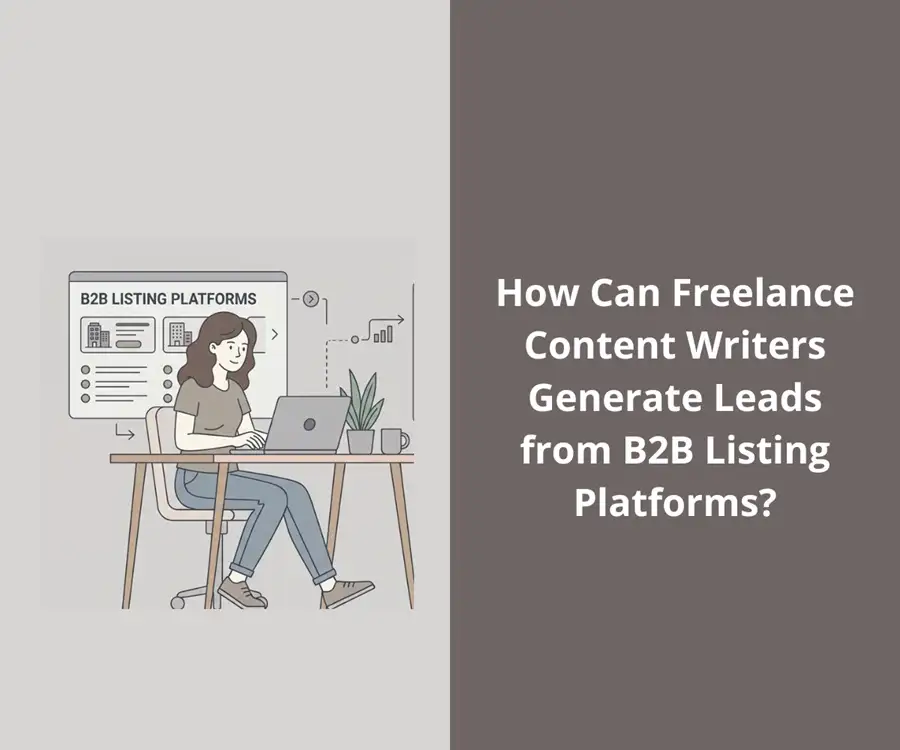
B2B listing platforms such as Clutch, GoodFirms, G2, Capterra, and TrustRadius are not just review sites. They have listed and verified data of several thousand companies, their websites, locations, and contact details. While the primary listing is useful for businesses that are looking for service providers, the same listing can be used by freelance content writers to generate leads. This article reveals how freelance content writers can use the B2B listing platforms to get high-quality leads. What is a B2B Listing Platform and What Can It Offer to a Freelance Content Writer? Buyers and companies seeking services, such as cloud computing services, logistics services, mobile app development services, IoT providers, Digital Marketing services, etc., conduct research before selecting a vendor. For this, they search companies on the B2B listing platforms. A B2B listing platform is an online marketplace. It connects businesses with other businesses. Sellers list products or services. Buyers search and compare offers. Deals often happen directly on the platform. The top B2B listing platforms include GoodFirms, Clutch, Capterra, G2, TrustRadius, SoftwareSuggest, etc. How do B2B listing platforms help freelance Content Writers?B2B listing platforms are a data source for freelance content writers to get the list of all large, medium, and small companies in various business sectors. How Freelance Content Writers Should Use B2B Listing Platforms to Get Leads? Turning Listing Data into a Lead List: Step-by-Step Process Step 1: Go to the B2B platforms’ official site Freelance content writers must go to the B2B listing platforms’ official website. On their homepage itself, there will be a menu that shows the service, product, and solution listings (category-wise). Step 2: Access the Business Vertical and Niche Every platform lets you filter listings by industry (IT, Logistics, Manufacturing, AI, Cybersecurity, etc.). You can go and select the listing as per your area of interest and content expertise. You can further filter the listing by niche or category. For instance, in Manufacturing, you can shortlist solar companies or biomass companies; in IT, you can further shortlist mobile app development companies or CRM software providers, and more. Do this based on your niche and domain. A narrow niche based on your portfolio, prior experience, and expertise makes your outreach more effective. Step 3: Create a Sheet with these Details & Tracking Data Once you have accessed a list after the filter process. For each company, log these fields in a spreadsheet: You can also note their employee strength (0-10), (11-50), (50-100), 100+, etc. This data is also available with most B2B platforms. This sheet will become your primary campaign engine. Step 4: Check the company’s Content footprints The next step is to take one company at a time, go to its website and social media pages, and find content gaps. Look for these gaps: Make a note of the specific gaps per company. Save these notes in your sheet in front of the company. Step 5: Email to Official Contact or Key Person Email 36.5% of freelance writers get work via cold emails. Once you have identified which companies have content gaps, you can send them a professional email mentioning their Content gaps, your key services, your portfolio, and how hiring you will solve their content issues. Keep the email short. Emails between 75 and 125 words, with about 20 lines including line breaks, tend to perform best. Mention the specific gap you found on their site in the subject line. Key Outreach Insights Company size matters: Small companies often reply faster than large enterprises. Companies with 11 to 50 employees show notably higher reply rates than enterprises with over 100 or 500 employees. Seniority matters: Founders also tend to respond more than executives further down the chain. Founders and owners reply more often than any other seniority group, ahead of C-level executives. Best first targets: This means small and mid-size companies from your B2B list are often your best first targets. Multi-channel wins: Using more than one channel pays off. Combining email, LinkedIn, and other channels can lift results well beyond email alone. Some Precautions or Best Practices Before Sending the Email List of Top B2B Listing Platforms and their Website Link Here are the most trusted B2B listing platforms for freelance writers. Each one covers a different mix of industries, so it helps to check more than one. Platform Best For Clutch IT services, software development, and digital marketing agencies. Reviews are verified through client interviews, which makes the data reliable. GoodFirms Software, web development, and marketing companies worldwide. Ranks providers by research score, not just star ratings. G2 SaaS and software products. A strong source if your niche is software, HR tech, or martech companies. Capterra Software-heavy directory, owned by Gartner. Useful for finding small and mid-size SaaS companies that often lack strong content. TrustRadius Business software reviews with detailed buyer data. Good for B2B tech companies selling to enterprise clients. SoftwareSuggest Strong coverage of Indian and Asian software companies, alongside global listings. Tip: Start with one or two platforms in your niche instead of all of them. This keeps your lead sheet manageable and your outreach focused. Wrapping Up B2B listing platforms have data that is already sorted, verified, and free to access. Freelance content writers just need a clear process to turn that data into paying clients. As per the process detailed in this article, freelance content writers can build their sheet, check a handful of companies for content gaps, and send personalized emails each day. Consistency matters more than volume here. Over time, this method builds a steady lead pipeline without ad spend or expensive tools. It also positions you as a writer who understands a company’s real content gaps, not just a generic pitch sender. That difference often decides who gets the reply. FAQs Is it legal to access the data of B2B listing platforms? Accessing this list on their official website is legal if you use it for your individual purpose and not with the intention to sell the data to any other party.

Top 12 Content Writing Trends to Watch in 2026
Content writing has changed in 2026. AI-assisted writing is now a reality and also a need. It has improved the research capacities of writers. AI also helps in creating the first draft or initial content. What’s more? The writer’s block is now over. If you get stuck, ask AI. You would get something that was really difficult for you to think of yourself. Search has changed. Now, AI overviews dominate the search results. User intent is captured better by AI-driven algorithms than by the previous keyword-driven algorithms. Search results are highly relevant to user intent. Amidst this, the purpose and feel of content writing have also changed. While AI-assisted content writing is the biggest trend of 2026, user intent beating keywords, focus on GEO and EEAT, the rise of video content, and multi-purpose content format are other prominent trends that are driving the content writing industry. This article seeks to highlight the current and emerging trends in content writing. Top 12 Current and Emerging Content Writing Trends in 2026 2026 Content Trends A quick look at the 12 trends reshaping content writing industry, before we break down each one below. 01 AI-Assisted Writing 02 GEO-Friendly Content Writing 03 User Intent Beats Keyword 04 Focus on Primary Research 05 AI-Feel in Content is Not Accepted 06 Prompts are Getting Shorter 07 Interviews & Podcast Content 08 Focus on UGC Content 09 Shift Towards Video Content 10 Multi-Purpose Content Format 11 Entity Authority Matters More 12 Industry-Specific Content 1. AI-Assisted Writing As AI can be used to do primary and secondary research for content data collection and also to create first drafts, no one wants to waste time manually doing it. Everyone is typing prompts. AI does the rest. AI is now a co-writer, not just a tool. Writers use it for research, first drafts, and idea generation. Secondary research that took hours now takes minutes. AI scans multiple sources, pulls patterns, and gives a structured summary. Writers then verify and refine it. First drafts are no longer a blank-page problem. AI generates a starting point. Writers shape it, add insight, and fix facts. This saves time without cutting quality, if used right. 88% of Content Writing Industry respondents surveyed by Elorites confirmed the usage of AI writing tools (ChatGPT, Gemini, Writesonic, Claude, etc.) for assistance in writing. AI-assisted doesn’t mean AI-dependent. Writers must still verify facts, check sources, and add their own perspective. AI gives you a draft. It doesn’t give you judgment. 2. GEO-Friendly Content Writing As the AI overview is where the search audience is, all brands now want to get their content cited by the AI overview or want their brand to be featured by the AI. It is happening in two ways. So, what are content writers focusing on? They are trying to create GEO-friendly content apart from the SEO-friendly content metrics that they are already used to following. Companies hiring content writers for in-house or freelance roles now expect content writers to be well-aware of GEO/AEO tactics, too. Businesses now know that their ‘brand awareness’ depends on how often they are visible on AI overviews. Citations and Rankings are Equally Preferred NowGetting quoted by AI is a top priority apart from the top rankings on search engines. Many brands now want to be on top of search rankings for their commercial keywords and also want to be cited for informative keywords on AI overviews. 3. User Intent Beats Keyword Search engines no longer just match words. They try to understand why someone is searching. Are they trying to learn, compare, or buy? Inferring user intent is the biggest strength of AI over merely trained algorithms. Earlier, Google’s search algorithm matched the best content available against the keyword query typed by the user. Now, the AI-based algorithms do not take the keywords as a ‘whole set of information’ but rather try to see beyond it. They infer the search intent (users’ intentions behind typing those keywords). This changes the content writer’s focus from keyword-based writing to intent-based writing. A good writer now asks this question before writing a single line. An article meant to sell should include pricing, proof, and a clear next step. Matching the reader’s real goal now matters more than repeating a keyword or adding paragraphs deliberately to accommodate keywords. A real-life incidentOne of our clients asked for adding the ‘ATS (Application Tracking System)’ keyword in the Time Tracking Software content they sell. Now, this keyword doesn’t fit the context of time tracking software that is about employees’ work and time tracking software, while ATS is something that HR uses in the hiring process. The client sells both and therefore wanted to pitch both in the same content. Now, those coming on the time tracking page have nothing to do with ATS. This is how one mismatches the user intent and shows irrelevant content. This practice doesn’t work in 2026 and can create spam issues. 4. Focus on Primary Research What AI content writing can never beat? Primary research. In fact, Primary research was a trend in 2025 also. In our previous article on Content writing trends 2025, we highlighted this. What AI generates is based on already available information. Primary research conducted by questionnaire method, interviews, and accessing original documents such as case files, report files (that are only accessible by authorized methods), is unbeatable by AI. Primary research is taking the lead in content writing and is one of the top-performing content types. Also, more qualified backlinks are generated when websites publish original research work based on surveys and field studies. AI also quotes the statistics available from primary research pages. AI can interpret statistics but cannot generate them on its own. Note: If you use AI to cook data for primary research, it is an unethical practice and can hurt your brand’s credibility if your readers find it. Using AI to create fake primary research reports is unethical. If you are a content writer and your company forces you to generate

Video Content is the Future of Content Marketing
For almost 20 years, all progress we saw in digital marketing was built mostly on textual content. Blogs, webpages, whitepapers, research articles, etc., were the prime content form that built authority, brand trust, and online attention. That backbone hasn’t disappeared, but it has quietly stopped being the main attraction. As scrolling now surpasses the reading activity, video content format appeals more to the modern audiences than written text. Video has moved from an ‘emerging trend’ and ‘optional content form’ to the ‘core content form’ in the age of reels. 91% of businesses use video as a marketing tool in 2026. (Source: Wyzowl Video Marketing Statistics 2026). Moreover, modern audiences have a low attention span and not only expect businesses to deliver information in an engaging format but also in the shortest possible way. Therefore, short video format is gaining more traction. Short-form videos are becoming dominant force in marketing and are the flag bearers of the shift from textual to video dominant content marketing. If you can explain the 5 major fashion trends in 2026 in a 3-minute video, it will have more viewership than anyone who creates the same in a 10-minute video. This article explains how video content is the future of content marketing and digital marketing activities. From text to Video Content The Age of Reels Short videos and reels are now the most engaging branding content. Attention now resets in seconds Most viewers decide whether to keep watching within the first 2–3 seconds, leaving little room for the slow build-up that long-form text once relied on. Brevity now outperforms depth A 3-minute video covering 5 ITR rule changes will be watched more than a 10-minute version on the same topic. Modern audiences are extremely busy. Short-form drives the highest engagement Reels and Shorts generate roughly 2.5x more engagement per view than long-form video, and 73% of viewers say they prefer short clips when researching a topic. All How-to-Content is Now Video-based Rather than reading a step-by-step article on setting up Google Analytics 4, most people search for a 2–to 3-minute screen-recorded video that shows exactly where to click. Reels generate more leads than blogs A reel on the top 5 earphones in 2026 with a buy link in the description can generate more business than a blog on the same. The core skill shifted from writing to video creation Where authority once came from writing 2,000 well-researched words, it now comes from compressing the same idea into a tight 60–90 second video. Textual content is now far behind video content in engagement metrics. See these examples: Three Main Reasons Written Content Lost Its Appeal Three forces converged to push video to the center of digital marketing: 1. Scrolling surpasses reading: Scrolling, not reading, became the default way people consume information, and video is simply built for the scroll. Textual posts now get lower engagement than videos. 2. The brain prefers motion storytelling to paragraphs: Visual content is processed by the brain far faster than text, and this is a scientific fact. The human brain can recognize and recall motion, sound, tone of voice, and facial expression more easily than text that it has read. 3. Algorithms and search engines started rewarding it: Videos now command roughly 82% of all global internet traffic, and platforms from Instagram, Facebook, LinkedIn, and Google now actively prioritize video in what they choose to show people. Video Content 15 Reasons Video Content Is Leading the Future of Content Marketing Video content format has become the centerpiece of modern content marketing and digital marketing workflows. 01 Higher Engagement Videos hold attention far longer than text or static images. 02 Better Retention People remember up to 95% of a message from video, compared to just 10% from text. 03 Improved SEO Rankings Search engines favor pages with video content. (Source) 04 Mobile-Friendly Videos are easy to consume on smartphones, where most traffic now happens. 05 Boosts Conversions Adding video to landing pages can increase conversions by 30%+. 06 Builds Trust Faster Seeing real faces and hearing real voices creates a stronger emotional connection than text. 07 Algorithms Favor Video Platforms like Instagram, LinkedIn, and Facebook prioritize video reach. 08 Explains Complex Ideas Simply Visuals plus audio make tough concepts easy to grasp. 09 Higher Shareability Videos get shared far more often than blogs or static images. 10 Increases Brand Recall Videos stick in memory longer than plain text, boosting brand recall. (Source) 11 Works Across the Funnel Useful for awareness, consideration, and decision stages alike. 12 Real-Time Engagement Live streams create urgency and authenticity that pre-recorded content can’t match. 13 Short-Form Is Exploding Reels, Shorts, and TikToks match today’s shrinking attention spans. 14 Fully Repurposable One video can be cut into clips, captions, blog posts, and social content. 15 Higher ROI Over Time Video consistently outperforms other formats in marketing ROI surveys. Top Video Content Formats Every Content Marketer Should Know Top video content formats that work best for content marketing or digital marketing are short-form explainer videos, How-to videos, tutorials, brand’s behind-the-scenes videos (that show real people, office infra, a factory, etc.), and client testimonials. Here’s a detailed breakdown of the organic video types brands rely on most, with real examples of how companies use them. Video Content Formats 10 Video Content Formats for Content Marketing Below are the top video content formats prominently used in content marketing funnels. Awareness Explainer Videos Short videos explaining a concept with background animations are great for content marketing funnels. For instance, a content marketing agency and you are explaining a concept such as GEO in an explainer video. Explainer videos are one of the top content engagement elements. Consideration How-To Tutorial Videos Step-by-step videos regarding how to do certain things in any domain are the most searched videos by users who are looking a smart, simple and easy-to-understand solution for a problem they are facing. Rather than reading lengthy content on how to create a pop-up on a WordPress website, anyone would look for a

Future of Content Writing: Scope & Opportunities
If you are a content writer or aspiring to be one and are even slightly worried about the future of content writing or whether it will be fruitful to be a content writer in the future, then this article is for you. And yes, content writing’s future is intact, and doesn’t over due to AI. The future of content writing is lucrative, with many new opportunities created in the areas where AI cannot compete with human content. However, you need to understand that it is not the same industry as it was before Gen AI. A lot has changed, and we need to explore all aspects before we reach a conclusion. In this article, we will explore what a future of content writing looks like in the age of Gen AI and power-packed LLMs. We will also review the key opportunities that remain for content writers. Is the Content Writing Industry Still Lucrative? What’s its Future? The last two years have been dramatic for the content writing industry. It hasn’t seen as many changes in the previous two decades (2000-2010) and (2011-2020) as it has in the current decade (2021 onwards). In the post-2020s, artificial intelligence became more accessible. When the beta version of OpenAI was released in June 2020, the content writing industry underwent its biggest transition yet. Gen AI shook the core of the content writing industry. AI-based tools such as Grammarly already existed, but these were used for editing, improving, and refining the language. But generative AI was different. It could write like a human. It started the AI vs human content debate and changed the paradigm of content writing forever. However, we need to understand that AI doesn’t make the industry oblivious. It actually empowers it. Let’s discuss what the opportunities for content writers are amidst this AI advent: #1 AI is Just the Content Companion, not Replacement The earliest GPT models in 2020, 2021, and 2022 were still no match for human writers, but with subsequent launches and the latest versions of Anthropic’s Claude in 2025-26, even the most seasoned writers have begun to be awed by the capabilities of Gen AI tools. Writers now often use AI to research topics, draft content, and polish their work. They then add their expertise, domain knowledge, terminologies, experience, and unique insights that breathe life into every piece. It adds the depth and the perspective that AI often misses. Therefore, the content writing industry (worth nearly US$25 billion) remains extremely lucrative. Why? Because AI cannot replace content writers entirely. AI is still a companion, an assistant, and a tool that does most of the tough work and improves writing efficiency. #2 Verification of AI Content Done by Human Writers Only Also, to verify the AI output, all businesses employ content writers. All Gen AI tools still come with a disclaimer: ” The tool is an AI. It can make mistakes”. Even human writers make mistakes. But still, they are the ultimate source of approval. They are employed to detect AI hallucinations, errors, incorrect citations, and incorrect original source linking. Egen companies that use Gen AI are not blindly generating content from AI and putting it on their websites. They rely on human writers for verification, content control, removal of inaccuracies, refinement to add a human touch, and maintenance of brand consistency in the content. This is why human content writing jobs are still on the market. #3 Plenty of Content Writing Jobs are Still Listed on Job Marketplaces See the screenshots below of a Google search query: ‘Content Writing Jobs in the USA’. Indeed.com shows 1234 jobs, Glassdoor shows 1042 jobs, and LinkedIn shows 2000+ content writing jobs in May 2026. As seen in the job listing screenshot above, there are still many content writing jobs on marketplaces. The platforms and job marketplaces are posting content writer requirements every day. Also, if we search for content writing jobs on LinkedIn search, we find hundreds of hiring posts by HRs related to content writing. We can safely say that AI has not taken content writing jobs entirely in half a decade of its prominent existence. Also, millions of people worldwide work as content writers at various companies. contentwriter.co, a global content marketing organization founded in 2019 in Poznań, Poland, cites research in a LinkedIn post, stating that more than 239 million companies use content marketing. It means there is a potential job opportunity for 200+ million content writers worldwide. Source: LinkedIn Post by ContentWriter.co #4 Thought Leadership and Personal Brand Content Still Done Humanly Thought leadership and personal branding are increasingly becoming popular after 2025. As there is a boom in podcast content across platforms, every CEO/Founder knows that their audience and customers also want to hear their personal stories and experiences. This is where human content writers have significant leverage over AI. AI can write a competent article about “How to Build a SaaS Product.” But it cannot write about how a CEO managed a crisis period (unless the info is already available online). So, first-person narratives are still a major no-AI zone. Articles about how a CEO started a business or how their company builds a brand are something where AI cannot help. AI needs to know the context, and so you won’t find an answer directly by a prompt. So, CEOs, Founders, and highly revered professionals in their fields, such as specialist doctors, renowned lawyers, or investors, who want to share their experience or build their personal brand on social media, look for content writers to do it for them. AI cannot personally interview them or know about their experiences, failures, key decisions that changed their lives, or values they cherish. Content writing for executives, founders, and subject-matter experts is one of the fastest-growing niches in content writing today. Skilled content writers who can capture an individual’s authentic voice, key quotes, and skills and translate their expertise into compelling narratives. This is the greatest scope for content writers and also fetches them premium rates. #5 Niche Research-Backed
AI vs. Human Content: Which Actually Ranks Better on Google in 2026?
AI vs. Human Content? Which ranks better on Google? The content that wins on Google’s SERPs in 2026 isn’t purely human and isn’t purely AI. Neither its the mix of both. What ranks better on Google is the content that has genuine value for the user. Content that showcases reliable insights, a thought process behind creation, deep domain knowledge, extensive research, proper language structure, engaging flow, and user-friendliness ranks well on Google, easily beating any generic content created by either AI or humans. Currently, no AI chatbot can offer all that in one go. Prompt-based content production or automated content generation without human assistance won’t offer the originality Google seeks in content. But even if the content is human-generated and misses the key parameters mentioned above, it will not rank. So what actually ranks better on Google? Original, helpful, thoughtfully created, and domain-specific content with expert insights that genuinely satisfy user queries always beats generic content. Doesn’t matter whether it is human or AI-generated. However, our proprietary client data and other studies show that human-written content, including AI-assisted but human-generated content, outranks AI-generated content. Reason? Purely AI-generated content does not offer the EEAT content that Google craves for its users. Let’s go into the details: Why is there a debate between AI vs. human content? AI CONTENT vs HUMAN CONTENT: A COMPARISON Aspect AI Content Human Content Origin Machine-generated via ML models Written by human experts Speed Fast and highly scalable Slow and resource-intensive Originality Pattern-based, less unique Fresh, experience-driven Style Consistency Uniform across high volumes Varies between writers Cost Low cost at scale Higher due to human effort The question ‘Does AI content rank on Google?‘ gets asked about a million times a day in 2026. And the internet is full of confident, contradictory answers. Half of the tweets, LinkedIn Posts, Instagram reels, and articles on Google say AI content is totally fine. The other half says it’ll tank your site. So, everyone is kind of confused. Therefore, the debate between AI vs. human content is bound to happen as everyone is looking for a reliable answer. Why is it so important to get an answer to the question of AI vs. human content? Therefore, it’s probably the most pertinent question on the internet today: what should the content generation process be? Human or AI? The answer can be a game-changer for many. It can change how a website or company allocates its content marketing budget, or whether to employ more human writers or invest in premium AI content generation tools. The Concern is Only With AI-generated Content Before 2023, everyone was used to human-based content generation only. Also, one thing is clear: most believe that human-generated content (developed by expert/professional writers) has no issues at all. Those seeking an answer to the AI vs. humans question are concerned only with AI-generated content. Therefore, it’s prudent to review some real-world examples and studies on AI-generated content. Below, we have discussed some studies that show how purely AI content fares on the Google SERPs. 5 Real-World Examples (AI Content Can Lead to Trouble) Example 1: Sports Illustrated (2024) Sports Illustrated was caught publishing articles attributed to fake AI-generated authors and fabricated profile photos. (Source: BBC News). When exposed, the content was removed. They removed the content because it violated basic journalistic standards, and many journalists were horrified to see AI-generated content. The output was low quality, and fake profile pictures made it worse. So, AI content for journalism, news, and media coverage is generally not acceptable. Example 2: Grokipedia (Early 2025) Grokipedia, an AI-generated encyclopedia powered by Elon Musk’s Grok chatbot, initially gained traction in Google search results. It got launched in October 2025 with over 885K AI-generated articles. Although it initially gained traction, Google’s March 2026 core update has caused it to lose visibility. Interestingly, it has also lost visibility in AI overviews. SEO expert Glenn Gabe documented the decline publicly. (Source: Search Engine Roundtable) This is the biggest example of how pure AI publications without human insight cannot perform on Google SERPs. Example 3: Rankability’s ‘Seo For Dentists’ Test Rankability (the renowned SEO platform) tested content for the keyword ‘SEO for Dentists’ for months and found that AI-generated content on the same topic performed poorly. And as soon as they replaced it with a human content writer’s content, the results were positive. (Source: Rankability). They also studied 487 articles and found that Google’s algorithms somewhat favored human-generated SEO content. 83% of top results were human-generated content, not AI-generated. Example 4: The Semrush Finding That Made Headlines Semrush analyzed 20,000 URLs from the top 20 Google results and found something that sounds simple but has big implications: human-written content is 8 times more likely to rank #1 than AI-generated content (Source: Semrush). Semrush’s analysis found that human-written content claimed the No. 1 Google ranking 80% of the time, compared with just 9% for AI-only content. Example 5: Reddit’s Explosive SERP Growth Reddit is renowned for its human-generated, conversational, user-experience-based content, and its AI Overview citations have skyrocketed since 2025. Google AI Overviews cite Reddit in 28% of cases where user-generated content is used as a source. (Source: Search Labs). Google doesn’t just want human-sounding content; it wants content from people who’ve actually done the thing they’re writing about. Exception: Ahrefs analyzed over 600,000 pages and found that 86.5% of top-ranking pages contain some AI-generated content, and it doesn’t hurt the rankings What do these studies tell us? Most studies (except the Ahrefs study) indicate that human-generated content remains king. Now, let’s try to analyze these findings based on Google’s Core March 2026 update. Google’s Core March 2026 Update: (Google’s Take on AI Content) If we analyze the major ranking shuffles post-March 2026 update rollout, we understand that human content still has the edge over purely AI content. The rankings are now favorable towards: The March 2026 core update showed something new. Google’s systems are getting more precise. Google appears to be increasingly capable of evaluating content quality at

Why Bollywood Horror Film Content Needs a Shift From Bhoots to Zombies?
Introduction Right from the screening of the first Bollywood horror film, Mahal (1949), in Bollywood, the typical Bollywood horror movie archetypes, such as Bhoots, Chudels, Aatma, Brahma Rakshas, etc., have dominated all movies of the horror genre. When the horror film Go Goa Gone was released in 2013 as a zombie apocalypse movie, everyone was curious why the zombies replaced the typical Bollywood horror movie archetypes (all derived from Indian culture, mythology, and folklore), such as Bhoots, Chudels, Aatma, Brahma Rakshas, etc. The film Go Goa Gone was a very significant deviation from the stereotypes of Bollywood horror movies. This was the first instance where Indian filmmakers deviated from their usual horror content that includes Indian archetypes and adopted the western horror content element, the zombies. Moreover, Go Goa Gone received immediate acceptance, box-office success, and applause from the Indian audience. So, it is obvious to consider how Indian audiences accepted monsters that did not fit their cultural roots. What reasons paved the way for zombies in the Bollywood horror genre, which has always been obsessed with the Indian supernatural elements, rooted in age-old legends? Also, this post will examine whether horror film writers should now focus on modern horror archetypes and write scripts and stories featuring Western horror elements such as zombies, humanoids, and vampires. Let us try to seek answers. Reasons Bollywood Horror Content Needs a Shift from its Age-Old Archetypes Why did Go Goa Gone need to import modern horror archetypes from Hollywood? While Romance, action, suspense, drama, and comedy continue to be the mainstream genres in Bollywood, Bollywood filmmakers have experimented with ghosts, spirits, and paranormal movies aplenty. However, these movies focused on Indian horror elements such as Bhoots, Pisaach, Pret, Aatma, Chudel, Dayan, Rakshas, etc. Never before the film Go Goa Gone have Indian filmmakers considered it worthwhile to put their efforts and money into a zombie film. Popular Western Horror sub-genres such as Humanoids, Cenobites, Slasher Horror, Nature Horror, Mummy films, Body Horror, etc., have never been attempted in Bollywood. But Bollywood started a different journey altogether with the release of Go Goa Gone (2013). Why? There is always a need to change content based on the current audience’s taste. Today, the Indian audience is more knowledgeable about global movie standards than the old generation. With better access to Hollywood films on OTT platforms, their tastes, expectations, and approach towards movies have changed. Besides, there are multiple venues to access films that were censored in India. This may have been what prompted Indian filmmakers to create India’s first popular zombie movie — Go Goa Gone. Let’s see some more reasons as to why there is a need for Indian filmmakers to import the horror archetypes from Hollywood: 1. Sophistication of Fear Since primitive times, man has created objects to express his inherent fear. Initially, the primitive man feared nothing but Nature. He was afraid of lightning, storms, fire, bodies of water, and phenomena he could not comprehend. Gradually, when he learned to tame Nature, he was caught in a fix. He realized that it was fear that kept him alive for so many years, and now he cannot do without it. It may seem very absurd, but the truth is that man longs for his object of fear. He needs something to project this instinctive feeling. It is in this psychological dilemma that he created the Stereotypes of fear: ghosts, evil spirits, Rakshasas, the devil, and many more. All were the product of his own imaginative mind. With scientific development and the growth of modern society, man became sophisticated, and so his fears. In the modern world, there is little room for old stereotypes. Films such as Go Goa Gone represent the sophistication of fear, in which the monsters of the past are replaced by modern-day monsters such as zombies, vampires, humanoids, and cenobites. There is a need for Indian horror filmmakers to bank upon this change in the fear archetype. They cannot keep serving the old dish to a new-age audience. 2. Elite Indian Audience Recent Bollywood films portray NRIs and upper-middle-class characters who are sophisticated in their manners and relationships. This group is the ‘elite class’ of India. Most recent Bollywood horror films, such as Ragini MMS, Bhoot, Creature, Raaz Reboot, Alone, and Raaz 3, were set in modern India and featured upper-middle-class characters. With Globalization and rising per capita incomes in third-world countries like India, the upper-middle class is a large group of regular moviegoers. Filmmakers know their profits will come from the pockets of these elite moviegoers, so they try to keep their movies’ settings relatable to the elite class. Hence, zombies find their way into Bollywood film noir. 3. Financial Reasons Most of the Bollywood horror films are either directly copied or inspired by Hollywood horror films. The reasons for copying may be exclusive to different filmmakers, but the most important reason is the guarantee of success. Bollywood directors are under constant pressure to recoup their costs and recover their revenues. Copying a successful Hollywood film is the best way out. Many Bollywood filmmakers copy because they think an Indian remake of a successful Hollywood film will also be successful, provided the American movie can be adapted to reflect Indian sensibilities. 4. Familiarity Breeds Contempt Horror films are so popular because they reflect a country’s culture and the traditional superstitions that are part of its people. When Indian filmmakers make a horror movie, they do so with the understanding that the public genuinely believes in the existence of Aatma, Rakshasas, Vetaals, or Asuras (Indian horror archetypes). Filmmakers believe the Indian audience is familiar with the meanings of these horror archetypes. These archetypes have been popular in Indian religious scriptures; therefore, the Indian audience loves to see the traditional monsters from those scriptures on the big screen. Curiosity about the unknown is what drives horror movies, and even the Indian audience is no different. But as the saying goes, familiarity breeds contempt; over the years of feeding on the same content,

5 Key Types of Content Analytics to Dominate Your Niche
Publishing content without understanding its impact, implications, and impressions is not a strategic approach. Without content analytics, you will never know which type of content performs better, or which platforms it performs better on. You will also never fully understand what type of content to publish without analyzing your competitors’ content, business niche, and audience. This is why content audit and ongoing content analysis are key for sustainable digital results for your website or other digital properties, such as social media pages. Content Analytics is the process of using tools, methodologies, and analytics expertise to measure, analyze, and interpret how your content performs across different digital platforms. By dissecting everything from keyword rankings to audience sentiment, content analytics empowers content marketers and content writers to move past the guesswork phase and enter a realm of precision in writing and publishing quality content. To truly dominate your niche, you must view analytics not just as a post-launch report, but as a continuous loop of intelligence that guides your content ideas. So, want to rank in your digital space? Want to be among the top searches online for your industry or business niche? Content analytics, along with high-quality, engaging content, is the key to success. This article explores the five types of content analytics that help you dominate your business niche in the online world. 5 key types of Content Analytics Before we dive into the types of content analytics, let’s take a look at the following statistics. The above stats show how important and valuable content analytics is. Now, let’s discuss the content analytics types in detail: 1. Competitor Content Analytics In content writing, competitor content analysis means to know: All the results you achieve through your content marketing efforts must be cross-checked against your competitors’ content performance. You cannot afford to let your competitors outshine you with more compelling, better-ranked content. To align yourself with industry standards, competitor content analysis is crucial. Most brands suffer due to inaccurate content audits and poor content forecasting. Not knowing your competitors’ content strengths and weaknesses can put you in a difficult position in the long term. However, with the right competitor content analytics, you will outshine your peers by knowing everything about their content strategy before they make their next move. No matter what content channels your competitors are using, you can strategically outsmart them with sharper, more impactful writing based on insights achieved from content analytics. So, what to do? Focus on top competitors: their content formats, ranking keywords, backlinks, content USPs, current audience, blog strategy, social media content, and PR articles, white papers, research articles, case studies, etc. Key Strategies: #Monitoring competitors’ content quality and performance: You need to check the content quality metrics competitors use, their writing guidelines and styles, and how they ensure industry-specific content. Monitoring content leaders in any segment and analyzing their traffic for changes in popularity and engagement helps you accurately assess your competitors’ content position and performance. #Tracking their content marketing strategy: Always track your competitors’ blog posts, content formats, editorial calendars, and social media narratives to understand which content markets to focus on. We optimize your content approach to help you reach the right audience and generate higher engagement and conversions. #Assessing competitors’ SEO Content Techniques: When your competitors outrank you with their content, they receive more customers and revenue. You need to find where their content ranks, which topics they are targeting, and which of their pages perform best. With a well-framed content strategy, your website will always have the upper hand. #Evaluating competitors’ content and social media coverage: Using brand monitoring tools, you can track your competitors’ online brand mentions, content marketing strategies, social media narratives, active platforms, and content ads. Such analysis proves fruitful in framing a content marketing and social media strategy for your brand. 2. Content Performance Analytics As generative AI spreads its wings in content marketing, brands need to be more vigilant about how their content performs across channels. From brand awareness campaigns to product storytelling, businesses need content performance analytics to measure the success of content campaigns, web performance, and content marketing initiatives. The first thing businesses should apply analytics to is their website content. The website is the primary hub for customer engagement and information. An accurate analysis of content performance and customer engagement on this channel is of prime importance to gain valuable business insights. Analyzing what customers say about your content, blogs, products, and services can provide the data you need to make future content decisions. Blog comment sections, forums, and discussion threads should be monitored to understand how audiences are responding to your written assets. Text analysis tools, sentiment analysis tools, NLP-based tools, and AI can help in analyzing comments across various web properties, including your social media channels. You need to monitor content performance metrics to improve the efficiency of your campaign tracking, helping you minimize or optimize content production and dissemination costs. Key Strategies: #Google Analytics: Use Google Analytics to understand what kind of traffic your content is generating, which blog posts or pages are most viewed, your visitor demographic, exit pages, referrals, and devices used. #Performance Analytics Tools: Use advanced analytics tools that provide a 360-degree view of your content metrics in real-time, from your Search Console and paid tools to third-party platforms. Know exactly which metrics are required for efficient content analysis. #Advanced Content Performance Analytics: Site traffic analysis, detailed visitor analysis, blog engagement analysis, email analytics, user behavior analytics, and organic search analytics fall under this category. Deeper analysis includes position analysis and content testing. 3. Business Content Analytics Every business is different, and so should be its content strategy. Business content analytics means analyzing content based on business niche, industry segment, and brand specifics. Business content analytics require a high-end understanding of your target audience, industry terminology, business specific jargons, and frameworks, etc. Business content analytics can help rejuvenate stagnant content, resolve long-pending content issues, mitigate comprehension challenges, and unlock superior content performance. It develops a
Using Movie Examples in Content to Boost Engagement Metrics
Introduction Content writing for marketing purposes is tough, especially when it comes to engagement metrics. It is difficult to engage your audience with marketing content (blogs, web pages, service pages, ads, etc.). Content writers must contend with endless scrolling if they cannot create content that keeps website visitors engaged. While there are many elements that make content engaging– such as graphs, tables, images, anecdotes, stories, etc., by which content writers try to enhance the engagement metrics and prevent their readers from leaving their content very soon, using movies can be a very result-oriented approach. Famous movies, scenes, dialogues, and characters are a strong source of engagement for content writers. Using movie references in content can turn even the most dry posts into immersive experiences. Integrating cinematic elements doesn’t just make your writing more fun; it connects with the psychology of your audience readily, as most readers will easily comprehend the movie scene or dialogue and how it fits into the content context. This article explains in detail how content writers can use movies to create engaging content that nourishes the appetite of their readers and keeps them interested in the content. Three Ways to Use Movies for Engagement Boost Movies can create deeper connections with viewers and quickly trigger memories. When you use their reference in your content, you can not only explain complex concepts more easily but also capture the viewer’s attention. For instance, if you are explaining how poor competitor analysis, stubborn attitude, and delayed decision-making can harm a business, starting with the example from the movie Lamborghini: The Man Behind the Legend (2022) can be a strong engagement hook. This film shows how inaction, competitive ignorance, and a stubborn attitude cost Ferrari, and how Lamborghini, which originally made tractors, became Ferrari’s formidable competitor. Another example is Moneyball. It is a biographical sports drama about Oakland A’s general manager Billy Beane’s successful attempt to assemble a baseball team on a lean budget by employing unconventional computer-generated analysis to acquire new players. The film teaches group dynamics and the role of ‘change’ and ‘innovation’ in any business. Therefore, if you want to write about group dynamics, unconventional business approach, or innovations, reference the film Moneyball in your content. When you reference a popular film, you’re instantly creating a rapport with the audience. Familiar stories, memorable movie scenes, and popular characters evoke nostalgia, refreshing the audience’s memories and letting you capture their unwavering attention. There are three prominent ways to use movies for content engagement: Movie Scenes: A single scene can explain a complex idea. Movie Dialogues: One famous dialogue can communicate a brand message faster than a full paragraph. Movie Characters: A beloved character can represent your audience’s struggles better than any content. 1. Movie Scenes: How to Use For Engagement Metrics? For instance, if you are a finance content writer explaining concepts such as the economic crisis, risk management, or the stock market, you can cite the film Too Big to Fail, which chronicles the 2008 financial crisis. Many financial concepts can be learnt from this movie. Your audience can easily relate to the movie. Systemic risks and their consequences, how financial regulatory bodies operate, and the importance of contigency plans in the financial world are all concepts we can learn from the movie. See the scene below from the Too Big to Fail Movie: If you are writing about decision-making, a never-give-up attitude, or perseverance, quoting scenes from The Pursuit of Happyness is the best approach. Review the scene below from the movie that demonstrates how, even in adverse situations, honesty, grit, and calm behavior can deliver the desired results. The protagonist, Christ (Will Smith), goes directly to an interview after spending a night in jail and therefore doesn’t have time to change into a formal shirt. He runs to the interview place and still manages to crack the interview. without even wearing a shirt The American motion picture 12 Angry Men (1957) depicts an adapted closed-room drama in which a dissenting juror in a murder trial attempts to influence the verdict with his personal prejudices and biases. The film and its scenes can be quoted to illustrate concepts such as prejudice, bias, human psychology, the power of influence, and the complexities of the human mind, anger management, and leadership, among many others. If you are writing about events such as global warming, environmental causes, or climate disruptions, quoting from movies like The Day After Tomorrow or Geostorm is a perfect way to begin the article. More examples of how to use movie scenes for content engagement: Remember the scene from the film The Founder where Ray Kroc tells one of the McDonald brothers about why he chose to take control of the McDonald’s brand name. If you are writing about any cross-cultural business theme, no film better illustrates it than Outsourced. Outsourced is a lively comedy that dives into the chaos and charm of cross-cultural encounters and unexpected romance. When Seattle call center manager Todd Anderson (Josh Hamilton) is let go after his company shifts operations to India, he must journey overseas to train his successor. Immersed in a whirlwind of unfamiliar customs and workplace surprises, Todd navigates the vibrant streets of India, all while yearning for the comforts of home. Check out the scene below from Outsourced: https://www.youtube.com/watch?v=hGKCkvNk_zI&pp=ygUVZmlsbSBvdXRzb3VyY2VkIHNjZW5l 2. Movie Dialogs: How to Use For Engagement Metrics? If you want to create a highly optimistic note for your audience, then you can start with the dialogue from the movie Theory of Everything, where Professor Hawking gives a speech about the philosophy of life that helps you. “It is clear that we are just an advanced breed of primates on a minor planet orbiting around a very average star in the outer suburb of one among a hundred billion galaxies, but ever since the dawn of civilization, people have craved for an understanding of the underlying order of the world. There ought to be something very special about the boundary conditions of the universe, and what can be more
How to Build Social Media Marketing Funnels for Small Businesses?
Introduction If you run a small business or work as a freelancer or are a professional services provider, you’ve probably thought about using social media marketing to grow your business. However, using social media for marketing purposes needs a focused approach. This is where you can implement high-performance social media marketing funnels to grow your brand. You just need the right strategy to implement such funnels. Proper strategies can help your business grow and make your social media efforts pay off. This article will guide you through the steps to create social media marketing funnels that help your business grow. Using these strategies can help your business stand out. Why Social Media Marketing is Important? As of 2025, 65.7% of the global population is active on social media. (Source) 90% of consumers use social media to follow trends and cultural events. (Source) 78% of people prefer learning about new products or services through short videos. (Source) 83% of marketers report that social media is now their primary channel for acquiring customers. (Source) Video content is the future of content marketing. (Source) 4 Stages of Creating High-Performance Social Media Marketing Funnels for Small Businesses Want to grow viral on social media? Want to get quality leads from social media pages? Or want to increase your brand awareness by using social media’s immense power? But not sure how to begin? This article will help you! You just need an effective social media marketing funnel and a sound content strategy. What is a Social Media Marketing Funnel? In marketing, a funnel illustrates the steps a customer takes before making a purchase. With the rise of new marketing technology, funnels now reach across more customer touchpoints than ever before, including websites, social media platforms, and ad networks. Usually, the steps are Awareness, Consideration, Decision, and Advocacy. Funnels help you guide your customers from their first contact with your business to the final sale, thereby increasing your revenue and growing your loyal customer base. In the social media context, a social media marketing funnel is a marketing funnel that works through your business’s social media channels. It usually has four stages: At each funnel stage, you are required to create relevant social media content (posts, reels, stories, ads, etc.). To get the best results, small businesses should build, improve, and fine-tune each stage. Let’s look at each stage and what it includes: Stage 1: Awareness At this stage, your customers are exploring their options and might not even know your brand exists yet. This is your golden opportunity to introduce yourself by sharing content that solves their problems. So, you have to create social media content that helps spread awareness about your brand, business, products, services, and solutions by providing content that solves customers’ pain points. The best types of social media content for this stage include: #1 Educational posts Educational and informational posts/reels help your audience learn about a topic and find solutions to their problems. Sharing these videos on your social channels keeps leads interested, shows your expertise, and keeps your customers informed. Brands that focus on teaching their audience with helpful videos can reach more people. When you share useful information, people are more likely to find you. This method, called inbound marketing, builds awareness and trust in your brand. Share simple tips, how-tos, or explainers related to your industry. Example: A bakery sharing “5 signs your bread is actually fresh.” #pro tip: Post the video on YouTube and share the links on your social media channels. #2 Humor and Satire Posts Adding humor to your marketing is a great way to share your message. For example, meme marketing grabs attention and lets you highlight your products or services. Humor helps build trust and a stronger connection with your audience, which leads to more engagement. Light humor, trends, or memes (when relevant) help humanize your brand. Example: A playful post like “When you realize marketing is more than just posting once a week.” #3 Inspirational Posts Inspirational videos work well at the awareness stage because they motivate customers and can influence their buying decisions. These videos can also increase website traffic, as people may come back to watch them again. Sharing inspirational quotes on Instagram, Facebook, and Pinterest can help you reach even more people. For example, brands that sell protein products often create gym-motivation videos. These campaigns inspire fitness enthusiasts to stay active or motivate newcomers to start working out. When it comes time to buy protein powder, these brands are top of mind. #4 Problem-focused Posts In your social media posts, talk about common pain points your audience faces—without pitching your product yet. Example: A freelance content writer can create posts on the benefits of quality content for small businesses, 5 mistakes companies should avoid before hiring content writers, etc. #5 Short-form Videos & Reels Quick, engaging videos grab attention fast and are heavily favored by algorithms. Create short videos that explain a concept about your brand, product, or industry, or that provide a solution to an issue customers face. For instance, a company compliance provider can create a short reel on mandatory compliance for private limited companies and share it on Instagram and YouTube. #6 Infographics & carousels Posts Easy-to-scan visuals work great for first-time viewers who are just scrolling. A survey found that on Instagram, carousel posts have an average engagement of 1.92%, outperforming both images (1.74%) and videos (1.45%). For instance, if you are a digital marketing company, you can share a step-by-step process of creating and implementing Google Ads for Small Business and post it as an Instagram carousel. #7 Behind-the-scenes Posts Show the people, process, or passion behind your business. This builds early trust. Such glimpses of office life, staff interactions, and playful videos tend to get more engagement due to their organic nature. Creating such videos in the first stage (awareness) is good for building brand identity and awareness. Go for Paid Ads Besides organic content, you can use Facebook Ads, Instagram Ads,