

Publishing content without understanding its impact, implications, and impressions is not a strategic approach. Without content analytics, you will never know which type of content performs better, or which platforms it performs better on. You will also never fully understand what type of content to publish without analyzing your competitors’ content, business niche, and audience.
This is why content audit and ongoing content analysis are key for sustainable digital results for your website or other digital properties such as social media pages.
Content Analytics is the process of using tools, methodologies, and analytics expertise to measure, analyze, and interpret how your content performs across different digital platforms.
By dissecting everything from keyword rankings to audience sentiment, content analytics empowers content marketers and content writers to move past the guesswork phase and enter a realm of precision in writing and publishing quality content.
To truly dominate your niche, you must view analytics not just as a post-launch report, but as a continuous loop of intelligence that guides your content ideas.
So, what to rank in your digital space? Want to be among the top searches online for your industry or business niche? Content analytics long with quality content that is also engaging is the key to success.
This article explores the five types of content analytics that help you dominate your business niche in the online world.
5 key types of Content Analytics
Before we dive into the types of content analytics, lets galnce on the below statistics.
- The global content analytics market size is projected to grow at a CAGR of 18.9% from 2025 to 2030.
- The global content analytics market is projected to reach $23.12 billion dollars by 2031.
- Writing (29%), analytics (25%) and video (18%) are the top skills for senior content marketers in the US. (Semrush)
- Text analytics led the content analytics market with the highest revenue share of 30% in 2025
The above stats show how important and valuable is content analytics.
Now let’s discuss the content analytics types in detail:
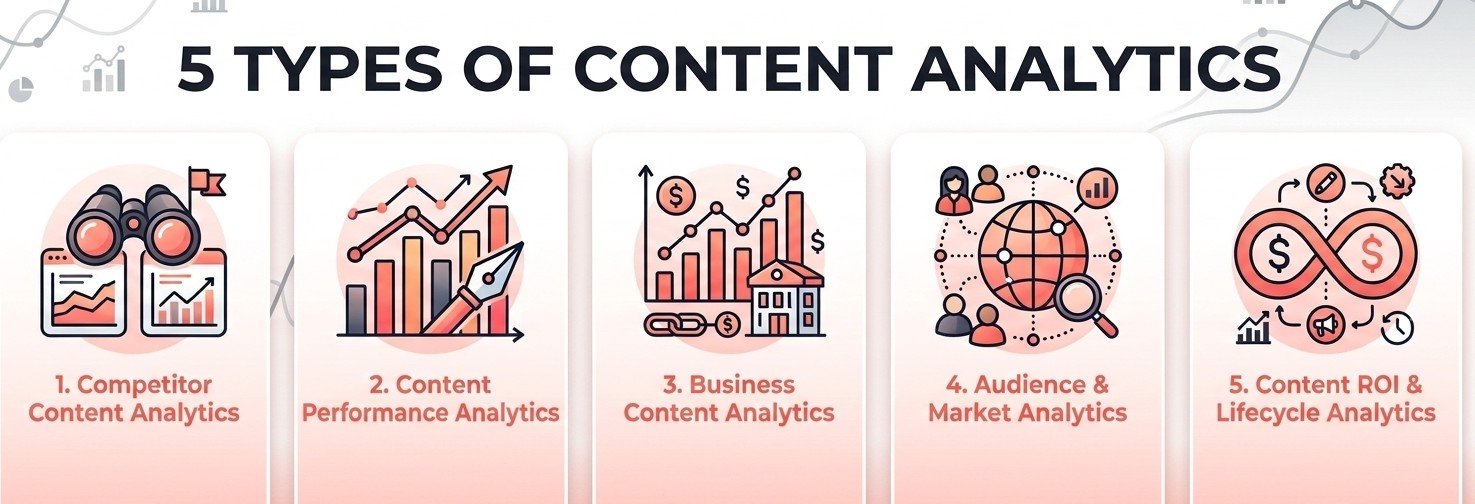
1. Competitor Content Analytics
In content writing, competitor content analysis means to know:
- What exactly your competitors are publishing?
- Where do they get their most traffic from? Means which blogs, webpages, social media posts are drivig the most traffic.
- What are their writing styles, formats, structure, content engagement elements, keywords, semantics, and other standards.
- Which channels are they publishing content?
- You can also get a fair estimate of their content marketing budget.
All the results you achieve through your content marketing efforts must be cross-checked against your competitors’ content performance. You cannot afford to let your competitors outshine you with more compelling, better-ranked content. To align yourself with industry standards, competitor content analysis is crucial.
Most brands suffer due to inaccurate content audits and poor content forecasting. Not knowing your competitors’ content strengths and weaknesses can put you in a difficult position in the long term.
However, with the right competitor content analytics, you will outshine your peers by knowing everything about their content strategy before they make their next move. No matter what content channels your competitors are using, you can strategically outsmart them with sharper, more impactful writing based on insights achiveed from content analytics.
So, what to do?
Focus on top competitors, their content formats, their ranking keywords, their backlinks, their content USPs, their current audience, their blog strategy, their social media content, and their PR articles, whitepapaers, research articles, case studies, etc.
Key Strategies:
#Monitoring competitors’ content quality and performance:
You need to check the content quality metrics used by competitors, their writing guidelines and styles, and how they ensure industry-specific content. Monitoring the content leaders in any segment and analyzing their traffic for changes, popularity, and engagement helps in the accurate assessment of your competitors’ content position and performance.
#Tracking their content marketing strategy:
Always track your competitors’ blog posts, content formats, editorial calendars, and social media narratives to understand which content markets you should also focus upon. We optimize your content approach to help you reach the right audience and generate higher engagement and conversions.
#Assessing competitors’ SEO Content Techniques:
When your competitors outrank you with their content, they receive more customers and revenue. You need to find where their content is ranking, what topics they are targeting, and which of their pages perform best. With a well-framed content strategy, your website will always have the upper hand.
#Evaluating competitors’ content and social media coverage:
Using brand monitoring tools, you can track your competitors’ online brand mentions, content marketing strategies, social media narratives, active platforms, and content ads. Such analysis proves fruitful in framing a content marketing and social media strategy for your brand.
2. Content Performance Analytics
As AI spreads its wings in the field of content marketing with generative AI competencies, brands need to stay more vigilant towards how their content is performing across channels. From brand awareness campaigns to product storytelling, businesses need content performance analytics to measure the success of content campaigns, web performance, and content marketing initiatives.
The first thing businesses should apply analytics to is their website content. The website is the primary engagement and information hub where customers interact with your brand. An accurate analysis of content performance and customer engagement on this channel is of prime importance to gain valuable business insights.
Analyzing what customers are saying about your content, blogs, products, and services can provide you with the data needed to make future content decisions.
Blog comment sections, forums, and discussion threads should be monitored to understand how audiences are responding to your written assets. Text analysis tools, sentiment analysis tools, NLP-based tools, and AI can help in analyzing comments across various web properties, including your social media channels.
You need to monitor content performance metrics to increase the tracking efficiency of your campaigns, helping you minimize or optimize the costs of content production and dissemination.
Key Strategies:
#Google Analytics:
Use Google Analytics to understand what kind of traffic your content is generating, which blog posts or pages are most viewed, your visitor demographic, exit pages, referrals, and devices used.
#Performance Analytics Tools:
Use advanced analytics tools that provide a 360-degree view of your content metrics in real-time, from your Search Console and paid tools to third-party platforms. Know exactly which metrics are required for efficient content analysis.
#Advanced Content Performance Analytics:
Site traffic analysis, detailed visitor analysis, blog engagement analysis, email analytics, user behavior analytics, and organic search analytics fall under this category. Deeper analysis includes position analysis and content testing.
3. Business Content Analytics
Every business is different and so should be its content strategy. Business content analytics means analyzing content based on business niche, industry segment, and brand specifics.
Business content analytics require a high-end understanding of your target audience, industry terminology, business specific jargons, and frameworks, etc. Business content analytics can help rejuvenate stagnant business content, solve long-pending content issues, mitigate understanding challenges, and unleash superior content performance.
It develops a gateway for businesses to adopt innovative storytelling methods to improve customer experiences, revenues, and profits. Its implementation can help businesses increase brand awareness, improve engagement periods, etc.
Business content analytics provides brands a vision for what audiences demand from the business and delivers content that solves their pain points. It also makes businesses capable of developing a strong content response mechanism for future requirements.
Key Strategies:
#Measuring key content KPIs:
Tracking your brand’s key content performance indicators, help you utilize your content resources optimally. With insights gained through data visualization, you can propose content methods and strategies that help you revive your brand and increase your audience reach.
#Recommendations:
Business content analytics can predict content trends, forecast engagement growth, and anticipate looming communication challenges for your business. Based on a detailed study of your brand, devise a concrete content recommendation plan that helps your business sail through the toughest of market conditions.
#Content Strategy Tools:
Using a mix of applications and analytics tools, carve out a perfect content plan for your business after analyzing all relevant factors. Minimize guesswork and devise a concrete content plan that delivers results. Understand what content trends you should follow, which storytelling strategies would work, which customer segments they should target, and how to structure their content calendar.
4. Audience & Market Analytics
Audience and market analytics are key to create content that is required by your clients, customers and purchasers. Therefore, audience analytics include studying audience behavior patterns, audience demographics, technicals (audience’s channels, OS, devices, browsing patterns, session times, etc.).
Market analytics is more inclined towards understanding the external environment in which your audience operates and makes decisions. Therefore, market analytics focuses on industry trends, competitor strategies, demand-supply dynamics, pricing patterns, and overall market behavior.
All content is created after thorough audience and market analysis.
Using models such as the media mix model, multi-touch attribution model, or unified marketing measurement model, brands can serve the right content to the right audience through the right channel.
With audience research data in hand, you can find the right content channels, correct timing for content launches, and the accurate publishing frequency for your content campaigns.
Key Strategies:
#Measuring analytics using tools:
Accurate measurement is a must for leveraging content analytics. Use sophisticated tools for performing measurement checks, including web analytics tools, visual behavior tools, SEO analytics tools, content analytics tools, social media analytics tools, and more. measure everything from competitors’ content strategy to your own campaigns’ quality.
#Demographic Analysis:
Using content analytics, know the demographics of your website’s visitors. Age, sex, browsing patterns, devices used, pages visited, country, city, etc. Gain a deeper understanding of your target audience and learn how to use content data for future success.
#Advanced Content Research:
Use advanced audience research tactics to measure contextualized customer data and engagement trends to craft recommendations for improving your underperforming content. See the big picture of your content efforts to deliver outstanding content campaigns.
5. Content ROI & Lifecycle Analytics
Understanding the financial return and the lifespan of your content assets is vital. Content ROI & Lifecycle analytics moves beyond simple vanity metrics (likes or views) to focus on the actual fiscal value (sales, subscriptions, purchases) generated by your content relative to its production cost.
Content isn’t just a one-time publication; it is a long-term asset. By analyzing the lifecycle of your content, you can identify evergreen pieces that continue to provide value years later, versus decaying content that requires a refresh or retirement. This ensures your content library remains an efficient revenue engine rather than a graveyard of forgotten posts.
Key Strategies:
#Tracking Content ROI & Attribution:
Move beyond engagement by using multi-touch attribution models to see which specific pieces of content contributed to a lead or a sale. By calculating the cost of production (writer fees, design, tools) against the revenue generated, you can determine your true Return on Investment (ROI) and double down on high-value formats.
#Content Cost-per-Result Analysis:
Evaluate the efficiency of different content types by measuring the “cost per lead” or “cost per click” for each asset. This helps in balancing your content mix—perhaps your expensive video series has a higher ROI than fifty low-cost social posts, or vice versa. Data-driven budgeting removes the guesswork from your marketing spend.
#Analyzing Content Decay & Longevity:
Every piece of content has a shelf life. Use analytics to identify when a high-performing post begins to lose its ranking or traffic (content decay). By identifying these trends early, you can strategically update or “re-launch” the content to reclaim its position, saving the cost of creating something entirely new.
#Repurposing & Multi-channel Impact Assessment:
Analyze how effectively a single “hero” asset (like a whitepaper) performs when broken down into smaller pieces (blogs, infographics, snippets). By tracking the cumulative performance of these repurposed assets, you can measure the “multiplier effect” of your content strategy and optimize your workflow for maximum reach.
Note: Based on the content types, content analytics take into account text analytics, image and video analytics, social media analytics, meta data analytics, etc. This we will discuss in another article in detail.
Conclusion
As we have explored, a truly robust approach to content analytics isn’t one-dimensional; it requires a 360-degree view of your ecosystem.
By mastering these five pillars—Competitor Analysis, Performance Analytics, Business Content Analytics, Audience & Market Analytics, and Content ROI/Lifecycle Analytics—you create a self-sustaining engine for brand growth.
You move from simply reacting to market trends to actively predicting them.
The tools are available, and the data is waiting; the only question left is how quickly you will use these insights to outmaneuver the competition and claim your spot at the top of the search results.
For a detailed content audit and content analytics guidance, you can connect with content marketing experts at Elorites Content.