
AI vs. Human Content? Which ranks better on Google?
The content that wins on Google’s SERPs in 2026 isn’t purely human and isn’t purely AI. Neither its the mix of both.
What ranks better on Google is the content that has genuine value for the user. Content that showcases reliable insights, a thought process behind creation, deep domain knowledge, extensive research, proper language structure, engaging flow, and user-friendliness ranks well on Google, easily beating any generic content created by either AI or humans.
Currently, no AI chatbot can offer all that in one go. Prompt-based content production or automated content generation without human assistance won’t offer the originality Google seeks in content.
But even if the content is human-generated and misses the key parameters mentioned above, it will not rank.
So what actually ranks better on Google?
| Original, helpful, thoughtfully created, and domain-specific content with expert insights that genuinely satisfy user queries always beats generic content. Doesn’t matter whether it is human or AI-generated. |
However, our proprietary client data and other studies show that human-written content, including AI-assisted but human-generated content, outranks AI-generated content.
Reason?
Purely AI-generated content does not offer the EEAT content that Google craves for its users.
Let’s go into the details:
Why is there a debate between AI vs. human content?
AI CONTENT vs HUMAN CONTENT: A COMPARISON
| Aspect | AI Content | Human Content |
|---|---|---|
| Origin |
Machine-generated via ML models |
Written by human experts |
| Speed |
Fast and highly scalable |
Slow and resource-intensive |
| Originality |
Pattern-based, less unique |
Fresh, experience-driven |
| Style Consistency |
Uniform across high volumes |
Varies between writers |
| Cost |
Low cost at scale |
Higher due to human effort |
The question ‘Does AI content rank on Google?‘ gets asked about a million times a day in 2026. And the internet is full of confident, contradictory answers. Half of the tweets, LinkedIn Posts, Instagram reels, and articles on Google say AI content is totally fine. The other half says it’ll tank your site. So, everyone is kind of confused.
Therefore, the debate between AI vs. human content is bound to happen as everyone is looking for a reliable answer.
Why is it so important to get an answer to the question of AI vs. human content?
- If AI content also ranks, why would any website owner bother to employ human writers for content generation? AI-generated content is much cheaper.
- Also, if AI content ranks on par with human content, it’s far more competitive to implement AI content generation to create content at speed and efficiency.
- If AI content ranks, then why would humans need to spend hours on content creation?
Therefore, it’s probably the most pertinent question on the internet today: what should the content generation process be? Human or AI?
The answer can be a game-changer for many. It can change how a website or company allocates its content marketing budget, or whether to employ more human writers or invest in premium AI content generation tools.
The Concern is Only With AI-generated Content
Before 2023, everyone was used to human-based content generation only. Also, one thing is clear: most believe that human-generated content (developed by expert/professional writers) has no issues at all. Those seeking an answer to the AI vs. humans question are concerned only with AI-generated content.
Therefore, it’s prudent to review some real-world examples and studies on AI-generated content. Below, we have discussed some studies that show how purely AI content fares on the Google SERPs.
5 Real-World Examples (AI Content Can Lead to Trouble)
Example 1: Sports Illustrated (2024)
Sports Illustrated was caught publishing articles attributed to fake AI-generated authors and fabricated profile photos. (Source: BBC News). When exposed, the content was removed. They removed the content because it violated basic journalistic standards, and many journalists were horrified to see AI-generated content. The output was low quality, and fake profile pictures made it worse. So, AI content for journalism, news, and media coverage is generally not acceptable.
Example 2: Grokipedia (Early 2025)
Grokipedia, an AI-generated encyclopedia powered by Elon Musk’s Grok chatbot, initially gained traction in Google search results. It got launched in October 2025 with over 885K AI-generated articles. Although it initially gained traction, Google’s March 2026 core update has caused it to lose visibility. Interestingly, it has also lost visibility in AI overviews. SEO expert Glenn Gabe documented the decline publicly. (Source: Search Engine Roundtable) This is the biggest example of how pure AI publications without human insight cannot perform on Google SERPs.
Example 3: Rankability’s ‘Seo For Dentists’ Test
Rankability (the renowned SEO platform) tested content for the keyword ‘SEO for Dentists’ for months and found that AI-generated content on the same topic performed poorly. And as soon as they replaced it with a human content writer’s content, the results were positive. (Source: Rankability). They also studied 487 articles and found that Google’s algorithms somewhat favored human-generated SEO content. 83% of top results were human-generated content, not AI-generated.
Example 4: The Semrush Finding That Made Headlines
Semrush analyzed 20,000 URLs from the top 20 Google results and found something that sounds simple but has big implications: human-written content is 8 times more likely to rank #1 than AI-generated content (Source: Semrush). Semrush’s analysis found that human-written content claimed the No. 1 Google ranking 80% of the time, compared with just 9% for AI-only content.
Example 5: Reddit’s Explosive SERP Growth
Reddit is renowned for its human-generated, conversational, user-experience-based content, and its AI Overview citations have skyrocketed since 2025. Google AI Overviews cite Reddit in 28% of cases where user-generated content is used as a source. (Source: Search Labs). Google doesn’t just want human-sounding content; it wants content from people who’ve actually done the thing they’re writing about.
Exception: Ahrefs analyzed over 600,000 pages and found that 86.5% of top-ranking pages contain some AI-generated content, and it doesn’t hurt the rankings
| What do these studies tell us? Most studies (except the Ahrefs study) indicate that human-generated content remains king. |
Now, let’s try to analyze these findings based on Google’s Core March 2026 update.
Google’s Core March 2026 Update: (Google’s Take on AI Content)
If we analyze the major ranking shuffles post-March 2026 update rollout, we understand that human content still has the edge over purely AI content.
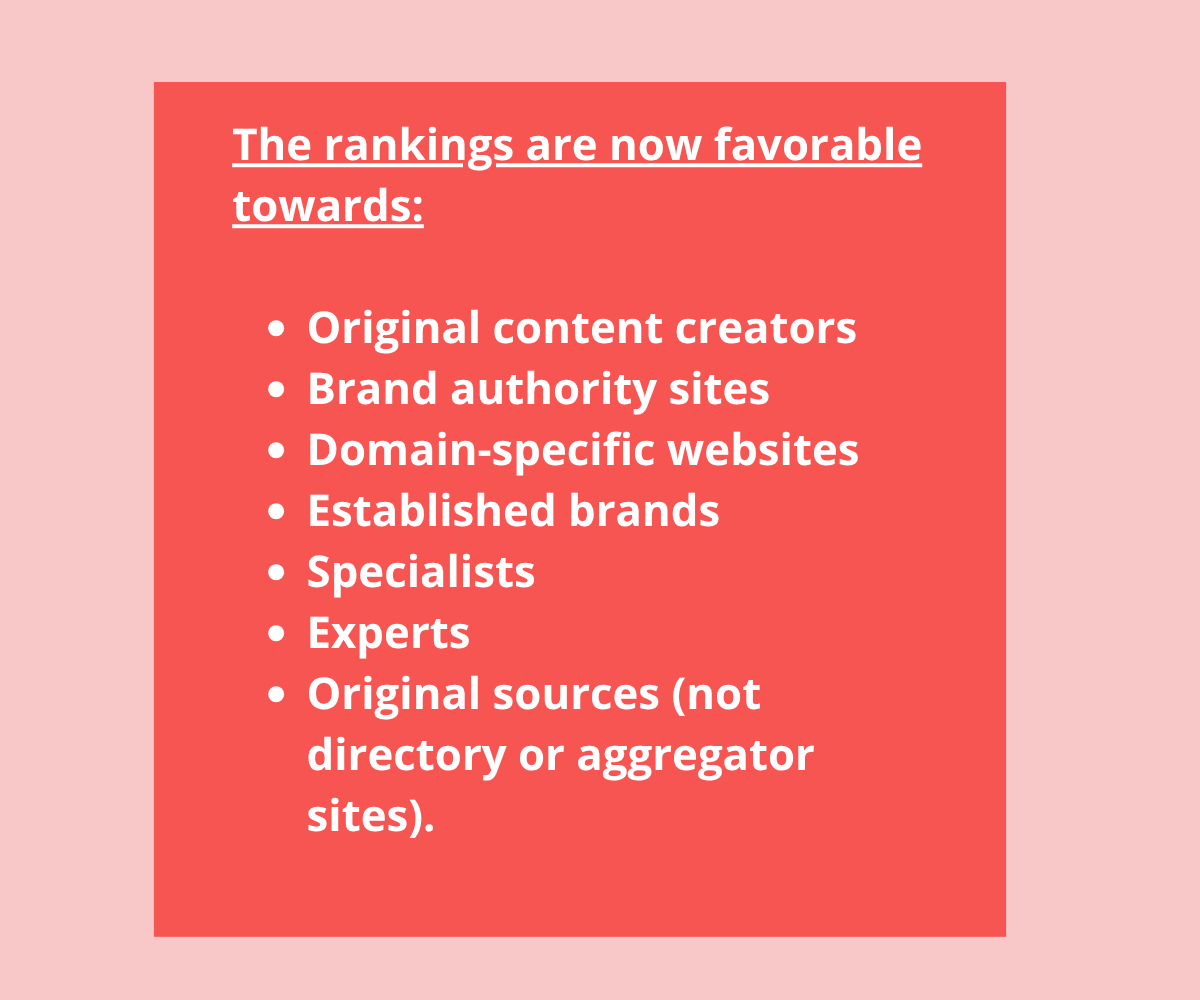
The rankings are now favorable towards:
- Original content creators
- Brand authority sites
- Domain-specific websites
- Established brands
- Specialists
- Experts
- Original sources (not directory/aggregator/comparative sites).
The March 2026 core update showed something new. Google’s systems are getting more precise. Google appears to be increasingly capable of evaluating content quality at the individual-article level, not just at the domain level. Sites that relied on scaled AI publishing saw targeted declines in their content (not blanket penalties).
Even when Google says it focuses on content quality, not how it is produced, its other spam policies can treat entirely AI-generated content as spam (mostly in bulk content-generation cases without human oversight).
| Without proper human edits, insights, structuring, value addition, reference linking to the original source, and engagement elements, the AI-generated content may offer little value to user queries. |
While automated AI-generated content can be useful for updating sports scores, weather forecasts, or YouTube transcripts in real time, its use to manipulate rankings with unhelpful AI content is considered spam.
Human Content Still Has an Edge
Insights, experience, authority, and expertise
If Google doesn’t actively penalize AI content, why does human-written content consistently outperform it?
There are structural reasons why generic AI content is not able to beat insightful and expert-created human content.
Let’s explain the three main reasons behind it:
#1 AI-generated content doesn’t always link the reference to the right source
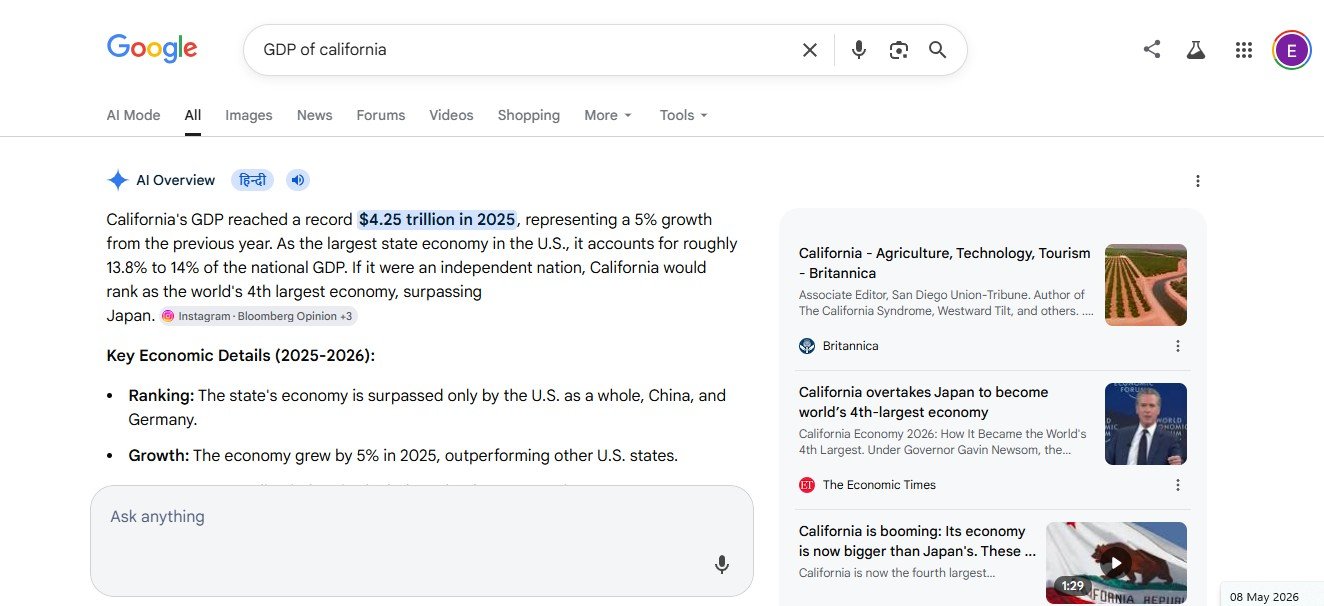
AI content mostly doesn’t link to the right/original source. It gives reference links, but they can be from any blogs/articles that its algorithms have gone through. Humans, on the other hand, know how to link to the original source. This makes it look less authoritative, and smart readers can detect it. For instance, if I have to write about California’s GDP, the right source will be the California State Department website. However, the AI overview by Gemini cites an Instagram Post by Bloomberg as its top source. Though correct, it is not the original source
#2 AI-generated content may offer low engagement
No matter how much input you give to AI, it generates the same type of repetitive words (now famous as AI-flagged words), similar sentence structures, etc. The engagement level is always somewhat low for AI content.
For instance, see the two paragraphs below:
AI-generated
(ChatGPT) Prompt: Write a 100 Words paragaph on Humanizing Content is The Worst Idea
| Humanizing Content is The Worst Idea Humanizing content is often promoted as the secret to engagement, but blindly following this idea can weaken professionalism and clarity. When writers focus too much on sounding casual, emotional, or overly friendly, the real message can get diluted. In industries such as healthcare, finance, or technical services, audiences value accuracy, trust, and expertise over forced relatability. Overusing humor, personal stories, or conversational fluff may undermine credibility rather than build a connection. Good content should solve problems, provide value, and respect the reader’s time. Human touch matters, but making everything excessively “humanized” can turn strong, purposeful content into distracting and ineffective communication. |
Human-written
Write a 100 Words paragaph on Humanizing Content is The Worst Idea
| Humanizing Content is The Worst Idea If you are writing using an AI tool to create content and then using another tool to humanize it, it will make it worse. Humanizer tools are awkward. They may change your ‘extract data’ into ‘pull data. ’Or ‘monitor trends’ into ‘look at trends. ’Or a simple line like ‘We understand your objectives before initiating the project’ into a very lame sentence like ‘We begin by asking how you plan to use the project’. While AI detectors may pass it as human! Trust me! The content misses the flow, intensity, and impact! Either don’t use AI at all, or at least stop humanizing it. |
Verdict: The structure, word choice, engagement model, examples, etc., produced by the human writer we have in-house (in Elorites Content) are far superior to ChatGPT’s output.
Human content tends to keep people on the page longer, drive deeper scroll, and prompt more return visits.
#3 E-E-A-T SIGNALS (AI cannot create the experience part)
‘Experience’ was added to E-A-T (making it E-E-A-T) in 2022 to help users get answers to queries that require experience (Google’s Quality Rater Guidelines). For instance, if I need a movie review, I would love to read results from people who have actually watched it (not an AI review). Now, the fact is that AI could fake expertise, but not experience.
The reason why you see interviews, survey results, and articles related to health, finance, law, etc., written with real-life human experience examples, rank better than AI-generated content.
Winning Formula of Google Rankings in 2026: AI or Human-Generated Content?
In 2026, the best approach is to let humans lead content creation, with AI providing support, not the other way around.
Here’s how this works in real situations:
Use AI for What It Does Well
AI tools are truly helpful when used for the right jobs:
- Speeding up research: Collecting data, summarizing studies, and spotting gaps
- Creating outlines: Building a basic structure for content.
- Handling repetitive content: Such as updating scores, weather information, updating listings and their content, or product descriptions on a large scale
- Laying the SEO groundwork: Grouping keywords, writing meta descriptions, and creating title options.
- Correcting spelling and grammar: Let the AI handle this.
These are support tasks. AI should act as an assistant, not as the main writer.
Let Humans Do What AI Cannot.
This is the key to ranking well. Let domain-specific, industry-specific, and experienced human writers offer:
- Define the intent sharply: Understand exactly what the user is searching for and what would genuinely satisfy that query. No AI does this better than a subject-matter expert.
- Original insights: Find new perspectives for the content draft that are not yet available online, from an authority, or as a quote/anecdote/opinion by a professional, such as a practicing doctor, a seasoned lawyer, a financial analyst, an engineer, etc. This is a task that generative AI cannot do.
- First-hand experience: The extra “E” in Google’s E-E-A-T, which AI cannot truly imitate
- Accurate source attribution/adding engagement elements: Linking to main, trusted sources instead of secondary blogs and creating language flows and content engagement elements (extremely relevant stories, images, graphs, stats, etc.) that keep readers on the page, reduce bounce rates, and earn return visits.
- Add Uniqueness: Share a unique case study, a client data point, an interview quote, a personal story, or the writer’s own opinion. This is what makes content stand out.
Wrapping Up
Google’s systems are not looking for a label that says “human” or “AI.” They are looking for content that is original, trustworthy, experience-backed, and genuinely useful.
In 2026, AI-generated content published in large volumes without human review or insight is more likely to be flagged as spam by Google. On the other hand, content made by real experts, even with some AI help, still performs well.
The websites that rank highest on Google today are not those making the most content. They are the ones creating the most credible, experience-based, and helpful content for users.