
Earlier, everyone praised standard English and sophisticated words like ‘leverage’, ‘enhanced’, ‘unlock’, ‘streamline’, etc. These words were the hallmark of sharp, professional writing? They filled the pages of Forbes articles, McKinsey reports, and Harvard Business Review op-eds. Clients and companies praised writers who used them. These words signaled clarity, sophistication, and command over the subject.
Not anymore!
Today, use any of them in a piece of content, and the verdict is almost immediate. Clients say, ‘This sounds like AI.’ Even an experienced content writer who uses these words gets flagged. Not for writing poorly. Not for plagiarising. Simply for writing well. Writers fear using these words even when they are the appropriate fit in many contexts.
So, AI has actually shaken the trust clients used to have in their writers! Gen AI has created a crisis of trust that the content writing industry is still struggling to address.
Pathetic! Right?
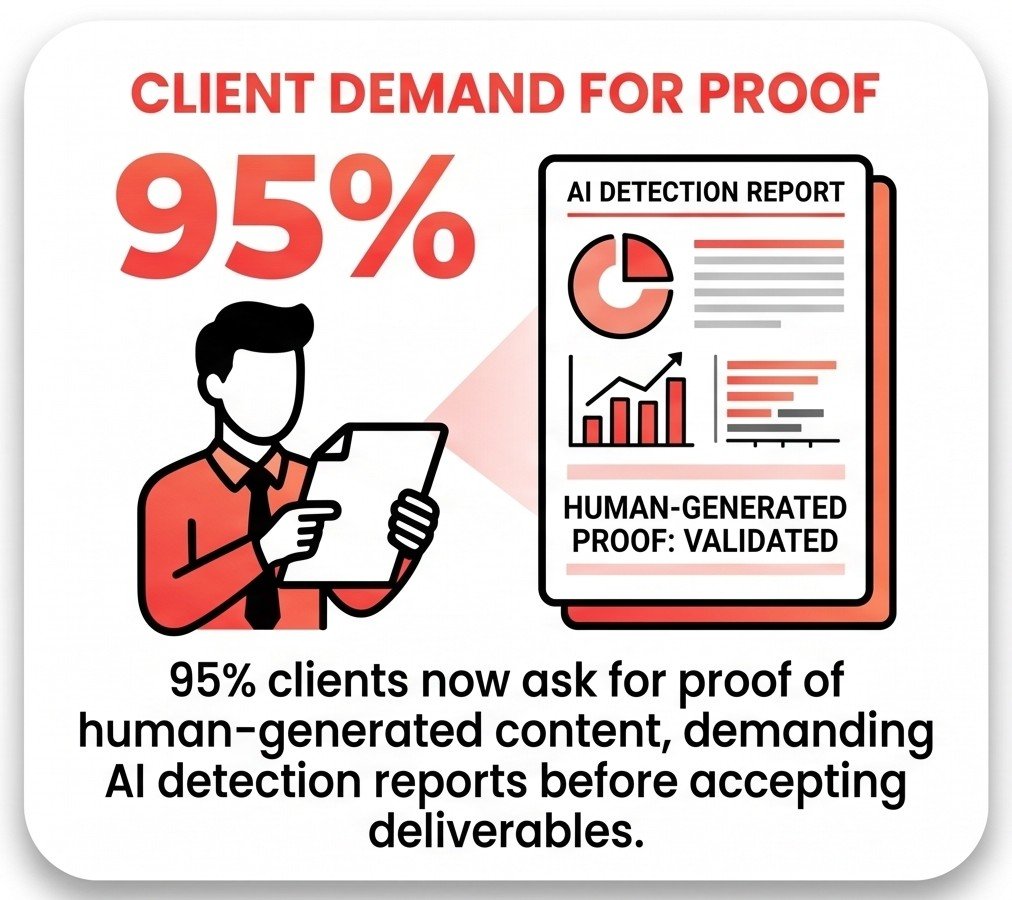
In fact, our latest survey on the impact of AI on the content writing industry revealed that 95% of clients now ask for proof of human-generated content.
The problem is that instead of focusing on content quality and rankings, clients only focus on AI detectors’ percentages.
This article examines how AI is eroding clients’ trust in content writers.
The Problem: Standard English Is Being Mistaken for AI
Let’s think about this clearly. For decades, writing coaches, English professors, and content strategists encouraged writers to use precise, powerful vocabulary. Words that convey meaning efficiently. Words that professionals in every industry actually use.
Now, those very same words are being cited as proof of AI-generated content.
| AI detection tools have done something no editor, SEO algorithm, or style guide has managed to do: they’ve made standard English suspicious. |
Here’s the uncomfortable truth: AI tools like ChatGPT were trained on millions of human-written articles. AI got trained on standard English content such as that published by Deloitte, Harvard, Forbes, industry whitepapers, and editorial columns. When AI produces content that mirrors standard professional English, that’s not a coincidence. That’s the training data working as designed.
Blaming a human writer for sounding like a professional is, frankly, a backward way of solving the problem.
Top AI-Flagged Words:
- Seamless
- Holistic
- Dynamic
- Nuanced
- Dive deep
- Multifaceted
- Streamline
- Enhanced
- Unlock
- Empower
- Elevate
- Foster
- Imperative
- Navigate
- Harnessing
- Leverage
- Ecosystem
- Delve
- Scalable
- Actionable
- Seamlessly
- Integrate
- Robust
- Comprehensive
- Game-changer
- Cutting-edge
- Crucial
- Innovative
- Tailored
- Transformative
- Proactive
- Best-in-class
- State-of-the-art
These are not AI words. They are English words. Flagging them as synthetic doesn’t improve content quality; it degrades it. And ironically, many clients force writers to “de-AI” their content or humanize it, making the content genuinely worse. Less precise. Less authoritative. Less likely to rank.
Here is perhaps the most damaging consequence of this shift: writers have started self-censoring. Not for ethical reasons. Not for legal ones. But simply out of fear that using the ‘wrong’ words will trigger an AI detector.
Words that once carried weight and were hallmarks of sophisticated English, such as ‘streamlined’, ‘cutting-edge’, ‘ foster’, or ‘imperative’, are now quietly dropped from many writers’ working vocabularies. Even if a term is the most precise fit for a given sentence, the fear of an AI label keeps writers from using it.
The result? Content that is technically ‘human-certified’ but linguistically dulled.
Elorites Insight:
Humanizing Content is the Worst IdeaIf you are writing using an AI tool and then using an AI tool to humanize it… it will make it worse… Humanizer tools are awkward: They may change your ‘extract data’ into ‘pull data.’ Or ‘monitor trends’ into ‘look at trends.’ Or a simple line like ‘We understand your objectives before initiating the project’ into a very lame sentence like ‘We begin by asking how you plan to use the project’. While AI detectors may pass it as human! Trust me! The content misses the flow, intensity, and impact! Either don’t use AI at all, or at least stop humanizing it. |
Client’s Trust in Content Writers is at the Lowest Point in 2026
“AI writing tools have triggered a crisis of trust between clients and the professional writers they hire. The trust has shifted from writer to AI detector tools,” says Varsha Jain, Director, Elorites Content.
Here’s what is actually happening in content writing companies, freelance platforms, and agency dashboards across India and globally right now:
- Writers with 5–15 years of experience are being asked to prove their content is human-written.
- Content that ranks consistently on Google Page 1 is being sent back for rewrites because it “scored 78% AI” on a detector.
- Writers are self-censoring their vocabulary, choosing dull and imprecise language over accurate, professional phrasing.
- Clients are terminating contracts not because the content underperforms, but because a third-party tool said it is AI content.
What Numbers Say: Elorites’ survey on Impact of AI on the Content Writing Industry
Elorites Content conducted a comprehensive survey in 2026, covering 1165 content writing firms, freelancers, and in-house content professionals across 22 countries, including India, the USA, the UK, the UAE, and Australia.
Here are some of the most telling findings:
- 95% of clients now ask for proof of human-generated content, demanding AI-detection reports before accepting deliverables.
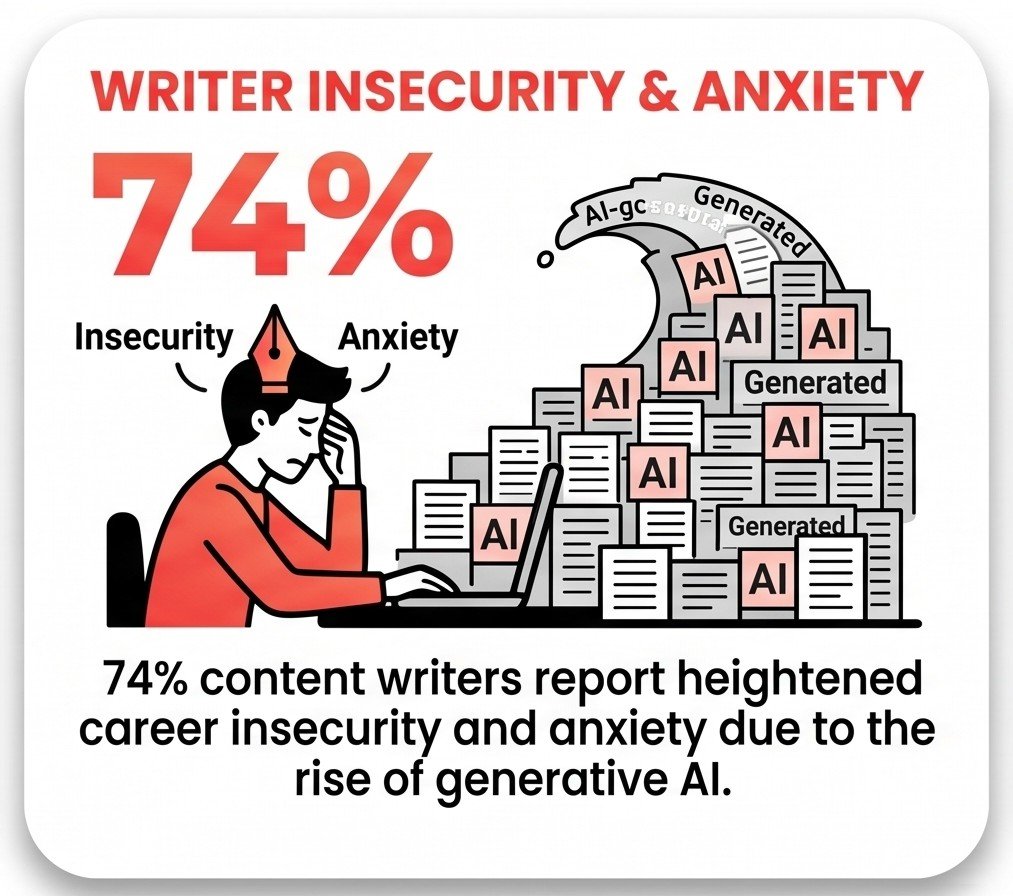
- 74% content writers report heightened career insecurity and anxiety due to the rise of generative AI.
 |
 |
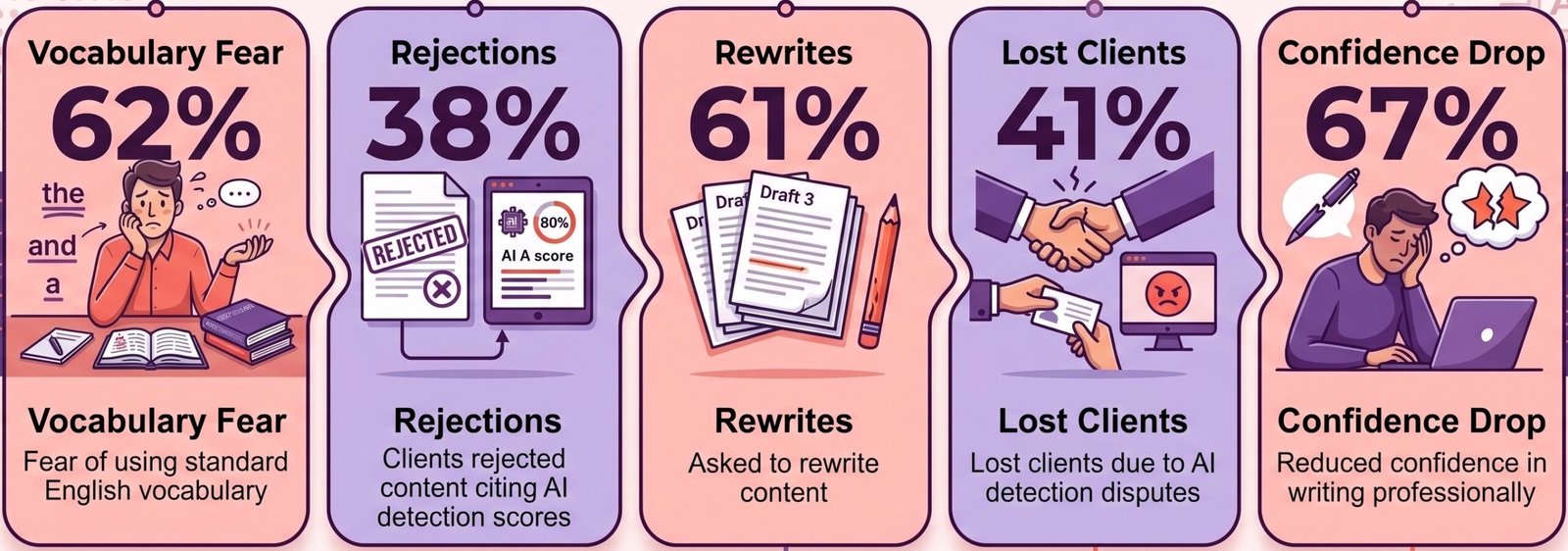
How Writers Are Affected by AI Detection?
| Challenge Faced by Writers | % of Writers Reporting This Issue |
| Fear of using standard English vocabulary | 62% |
| Clients rejected content citing AI detection scores | 38% |
| Asked to rewrite content | 61% |
| Lost clients due to AI detection disputes | 41% |
| Reduced confidence in writing professionally | 67% |
Source: Elorites Content Survey 2026
Still, there are positive views that AI cannot replace writers. Forbes’ article states that
AI Detection-Focused Content vs Quality-Focused Content: A Comparison
| Factors | AI Detection Focused Content | Quality-Focused Content |
| Objective | Pass AI detection thresholds | Rank on search engines, drive traffic, and leads |
| Language | Humanized (Simplified but awkward phrasing) | Contextual, Audience-oriented language |
| Content Quality | Compromised for humanness | Prioritized for depth, expertise, and industry-niche |
| Trust | Writer trust is low | Writer trust is high |
| Value | Uncertain long-term value | Strong long-term value |
Clients Must Focus on Quality, Rankings, and Content Logic Rather than on AI Detection Percentages
While search engines like Google have stated in their guidelines that they will only penalize low-quality content and unhelpful content, clients’ focus on humanizing it actually makes it substandard.
How?
The writer spends more time editing to pass AI detectors rather than structuring, researching, and adding original value to the content. Despite AI tools promising to make writers faster, 63% of writing professionals now spend more time editing, fact-checking, and ‘humanizing’ AI output than they would have spent writing the same piece from scratch.
Clients should focus on rankings, impressions, leads, traffic, and interactions that the content is driving rather than on AI detection scores.
Let your content writers demonstrate domain knowledge, industry expertise, and language acumen.
A Message to Clients: Trust Your Writers
Before you hire your writers, check their portfolio, domain knowledge, industry-specific writing skills, rankings they have achieved, their SEO expertise, and current and past clientele, but once you hire them, trust them for your content. Let them create content freely, without the pressure to pass AI detectors. If the content doesn’t perform, isn’t getting indexed, or isn’t ranking, you have the right to scrutinize their process and even end the contract. However, do not force them to dull their language (deliberately humanize) to satisfy flawed AI detectors.
Many of the writers you hire today have been working long before Gen AI tools such as ChatGPT, Claude, or Gemini even came into existence. So, rather than solely relying on AI reports, focus on real signals of content quality metrics
The question to ask your content team is not “Did this pass the AI detector?” The question is: “Is this content driving consistent organic rankings and qualified leads?”
Clients should focus on rankings and whether the content is bringing leads and organic traffic.
Do you want to receive high-quality content services? Is content quality your priority?
If so, then connect with Elorites Content to discuss your content requirements. We can provide you with a never-before-seen content experience.