Have you ever come to the realization that there is too much information on the internet?
Well, if you have, then chances are you’ve been experiencing a content shock.
Open YouTube or Instagram, and you see millions of shorts, videos, and reels on the same topics.
Open LinkedIn, and you see the same repeated posts with different timelines or by different people.
Open Google and search for any content, and you see hundreds and thousands of websites competing for the same keywords or different webpages in the search results with the same topic, and in many cases, the same content repeated in different languages.
What is happening?
The influx of content exceeds the rate of consumption.
Too much information on the internet.
AI is exacerbating the challenges faced by content creators, webmasters, and businesses seeking to create unique content.
If you are a content creator, website owner, or content writer, it is essential to understand how to mitigate content shock and protect yourself and your audience from its implications and adverse effects. This article will help you do so.
What is Content Shock?
Content shock occurs when someone becomes overwhelmed by the amount of information they need to organize and consume. It is a modern and digital form of sensory overload.
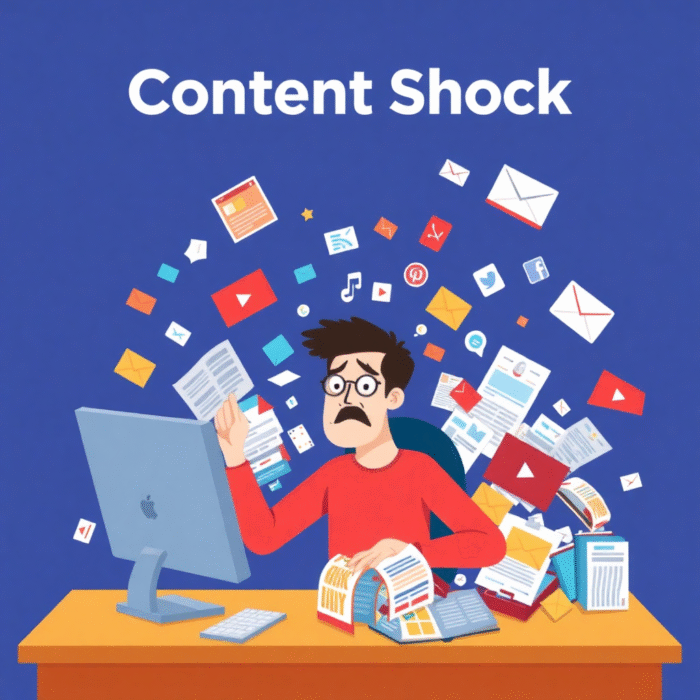
For a layperson searching digital channels such as websites, social media platforms, listing sites, aggregators, marketplaces, discussion platforms, and forums, the abundance of information is a significant issue. It hampers their ability to judge what information is really useful and which information they need to avoid.
Additionally, too much information creates the problem of filtering out low-quality information that may be misleading and generated for marketing or superficial reasons.
Reasons leading to Content Shock:
- Easy access to the internet, digital devices, mobile devices, content creation tools, and AI content generators.
- Low-cost hosting services and the free nature of search engines make it easier to publish content.
- Popularity of social media and its exponential usage (the scroll and reel culture) among Gen Z.
- Content marketing and digital marketing are becoming the core of marketing (preferred over traditional marketing media). It increases the need for published content.
- Tools such as drag-and-drop website builders, automated social media post generators, and Canva for designing, among others, make content creation more accessible.
Is Content Shock a Content Marketing Problem?
Content marketing has proven to be a powerful tool for businesses to establish their brand and generate leads. Brands use content marketing to establish themselves as experts in their field, deliver valuable information, prompt action from customers, and promote a product or service.
Currently, an entire army of content marketers is scrambling to capture attention for their websites or social media pages. Everyone is churning out page after page of articles simultaneously. While content marketing is important, content shock can render it ineffective.
You know that if you want to succeed in any area of life, being good isn’t good enough. For the sake of content marketing, all creators are churning out content without focusing on quality and differentiation.
Content Shock and Its Various Interpretations
Content is the lifeblood of every business. But today, people are drowning in the content sea. We’ve all had experiences where we’ve scrolled through thousands of articles to find a few good bits. Why is it? Yes, that is due to content saturation, which ultimately leads to content shock.
We have identified 5 Major Problems with this flood of content:
- Most online content is of substandard quality (written or developed by uncertified or unqualified writers).
- No mechanism to find the best quality content on the internet, except for the dependence on search engines’ algorithms.
- The quality of content varies across websites as well. Even the best-quality websites often produce mediocre content in certain sections.
- Too much content is being generated due to AI. However, most of it is paraphrased, rephrased, repurposed, and generated by poor prompts.
- Even the unauthoritative sources generate content at scale using AI. Such content has no value.
Let us see various interpretations of content shock:
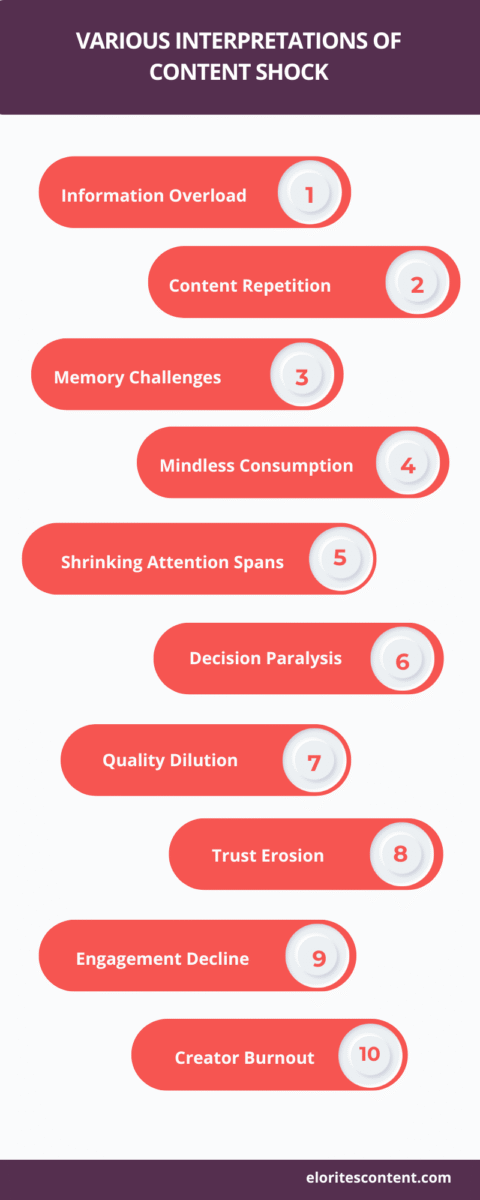
#1 Information Overload
Content shock occurs when we feel overwhelmed by an excessive amount of content everywhere. Reading articles, watching videos, or checking social media becomes exhausting because there’s simply too much to process.
#2 Content Repetition
Content shock occurs when the same content appears on multiple social media channels. This repetition can annoy followers, who may perceive it as spam and potentially lead them to unfollow or ignore future content.
#3 Memory Challenges
Content shock makes it hard to remember information because there’s too much coming at us. With smartphones and constant notifications, keeping up with all the content shared online becomes impossible, making retention difficult.
#4 Mindless Consumption
Content shock happens when you catch yourself scrolling through feeds without actually seeing what’s there, or opening articles without reading them. This zombie-like browsing (causing mental issues) is common among younger generations who grew up with social media.
#5 Shrinking Attention Spans
When facing content shock, people develop shorter attention spans for content. This leads to confusion as too much information hits at once, causing people to spend less time on each piece and reducing overall content quality. Too many digital devices and information overload shrink our attention span, says Dr. Gloria Mark, PhD, professor of informatics at the University of California, Irvine. (Source)
#6 Decision Paralysis
Content shock creates a paradox of choice where having too many options for content consumption leads to decision fatigue. People become unable to decide what to read, watch, or listen to next, often resulting in abandoning the search altogether.
#7 Quality Dilution
As content volume explodes, quality standards drop. Content shock refers to the phenomenon where the increasing volume of mediocre content makes it harder for consumers to find truly valuable information, creating a needle-in-a-haystack problem.
#8 Trust Erosion
Content shock leads to skepticism about all information. When bombarded with contradictory content from countless sources, people struggle to determine what’s trustworthy, eventually developing a generalized distrust of online information.
#9 Engagement Decline
Content shock explains why engagement metrics are falling. As audiences face overwhelming content volumes, their meaningful interactions decrease – they like, comment, and share less because they’re processing too much too quickly.
#10 Creator Burnout
Content shock affects not only consumers but also creators. The pressure to constantly produce fresh, engaging content to stay visible in saturated channels leads to creative exhaustion and diminishing returns on content investments.
Guardian’s article titled: ‘You can’t pause the internet’ explains how creators (social media creators) face burnout issues. It describes the dilemma of a creator who must constantly produce new content, even when they feel unwell. Otherwise, the algorithms will guide your followers to other active accounts.
| Note: If you are facing creator burnout, read this article on how to prevent creator burnout. |
Implications of Content Shock
So, what are the implications of content shock?
Content shock also affects your existing popularity. Let’s say you created a great product or a killer webinar, but a few weeks after its release, thousands of others have produced similar content (some better, some mediocre, and some of low quality). This will affect your content’s engagement, and soon, people will lose interest in reading the same type of content in different forms.
The majority of the content on the web today is of mediocre quality, with even the most popular websites and brands carrying poorly produced content.
- You’ll have a hard time creating enough fresh content to stay relevant.
- Your content is ineffective or irrelevant
- Your content is too small to be useful
- Your content is too long and boring
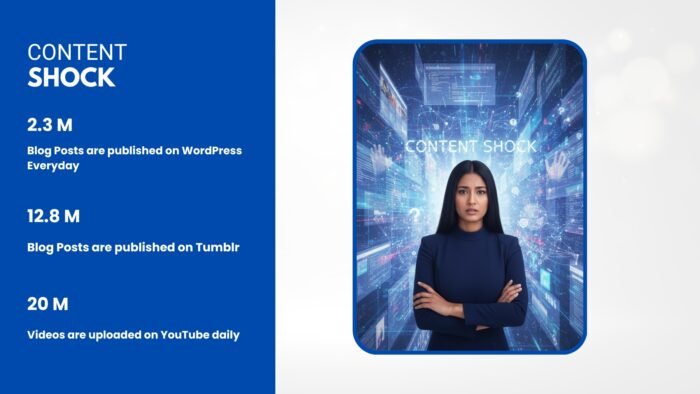
Let’s discuss the major implications of content shock:
#1 Paying Audiences to Read Content
Mark Schaefer used the term ‘Content Shock’ to refer to the risk of the content marketing world being overwhelmed by too much low-quality content and the risk of paying audiences to read your content. He was referring to the costs involved in creating content. Additionally, as content supply exceeds demand, content marketers must spend more on ads, sponsored content, and guest posts to make their content visible to readers.
#2 Mediocre Content is No Longer Effective
As content marketing becomes increasingly competitive, mediocre content will no longer be effective. In short, if content marketing produces mediocre content on a large scale, there won’t be enough people to consume it. Search engines, such as Google, know how to tackle low-quality, spammy content.
#3 Entry Barriers High for New Websites
New websites face significant challenges breaking through in saturated markets. Without an established authority or audience, newcomers must invest heavily in exceptional content or distribution channels just to be noticed among established competitors. New entrants must contend with issues such as low domain authority, poor backlinks, and content saturation. Finding new and relevant content topics is a major challenge for them.
#4 Rising Content Development Costs
As competition intensifies, businesses must invest more in high-quality production, expert writers, original research, and multimedia elements to stay competitive. The days of cheap, text-only content are coming to an end as audience expectations rise and attention becomes increasingly harder to capture.
#5 Audience Fragmentation
Content shock causes audiences to fragment among multiple sources of content, and therefore, content creators face issues with traffic. Content shock, or content saturation, creates more avenues for audiences to consume content; therefore, even the most trusted sources may see a decline in traffic as others are quick to imitate their content. rather than mainstream channels..
#6 Shortened Content Lifecycles
The useful lifespan of content continues to shrink. What once generated traffic for years may now become obsolete in weeks or days as similar content floods the market. This accelerated lifecycle forces more frequent content refreshes and updates.
All of those problems are solvable with the right content strategy.
What are the Best Ways to Mitigate Content Shock?
We all want our content to be read by as many people as possible. But how do we make sure our content is engaging?
Content marketing has become increasingly important in today’s digital marketing landscape. Companies are relying more on content than ever before to stand out and get noticed.
With the advent of paid social media ads, content is now more competitive than ever. As a result, companies must enhance the quality of their content to differentiate themselves from the competition.
“Content Shock is real — there’s just way more content out there than anyone can keep up with. But instead of freaking out, we should see it as an opportunity to become smarter about what we create. It’s about making content that actually matters to the people we want to reach”, says Jayesh Mehta, the CEO and MD at Elorites Content.
There are ways to manage the overload of content to mitigate the content shock:
Step 1: Research Topic
The best way to address the content shock issue is to conduct extensive research before selecting a topic for creating a blog, reel, post, podcast, or any other piece of content. For this research work, you can conduct an extensive study using Google Trends, Google Scholar, or utilize tools such as Topic Finder Tools, Search listening tools, and niche topic finders.
You should also conduct a comprehensive competitor analysis to check their topics and avoid those that are very similar to or already have substantial content on. However, if you can identify the content gaps, you can create content that bridges the gap.
Example: If many blogs cover “healthy eating,” but none focus on “healthy eating for busy parents,” you can create content for that specific group.
Step 2: Focus on Quality Over Quantity
Instead of making lots of average content, create fewer pieces that are really helpful and well-made. Internet users prefer useful, well-written articles over many low-quality ones. For developing quality content, you can follow Google’s guidelines for high-quality content, and you can also use Elorites Content’s writer’s guidelines to create quality content.
Additionally, to create unique and original content, you must develop ideas, identify content gaps, and conduct primary research to incorporate original facts and statistics. Share your personal experience of learning a new skill, or conduct a small survey and publish the results.
Step 4: Optimize Content for User Intent
“Don’t think about content shock in a negative way. It actually pushes us to be better creators”, says Sandhya Solanki, the senior content writer at Elorites.
Think about what your audience wants to know and answer their questions clearly. Use keywords naturally so that people can easily find your content.
Example: If people search “how to fix favicon issue,” write a step-by-step guide that solves this problem. However, people may specifically want to know ‘how to fix the favicon issue in WordPress’. Therefore, the second title is more specific and may appeal more to user intent, as people generally encounter favicon issues in a particular type of development environment.
Step 5: Use Multiple Content Formats and Elements to Increase Engagement
People like to learn in different ways. Mix things up by using videos, infographics, podcasts, and articles to keep your audience interested.
Additionally, to make the content engaging, incorporate elements such as graphs, facts, anecdotes, storytelling, tables, analogies, examples, and illustrations. Read our article on 15 Elements that Make Your Content Engaging to get the most out of content engagement elements.
Step 6: Ask Audiences
Engage with your audience through comments, social media, or email. When people feel connected, they are more likely to return and share your content. Understand their pain points and types of content they would like to read more of.
Also, find out what topics they are unable to find content about. Check which content people like the most and make more of that.
Step 7: Collaborate with Subject Experts
Writing content without expertise will never bring the results you need. One effective way to create high-quality content that avoids content shock is to collaborate with subject matter experts.
Collaborate with individuals who already possess extensive knowledge about your topic. This is the best approach, as your content will have the vision it needs to differentiate itself. Also, you can search for the best research sites and quality publications for good content.
Step 8: Promote Content Smartly and Keep Updating
Utilize ads, social media, and email to target your content to a specific audience instead of a broad one. Example: Run Facebook ads targeting new parents if your content is about baby care. Update your old content regularly to ensure it remains useful and accurate. Evergreen content remains relevant for an extended period. Update your “Best Smartphones of 2023” article annually with the latest models.
| The internet is a crazy place. There’s a lot of noise on the web, and it can be hard to break through the clutter. You have to be great! It takes time and effort to create really engaging content. |
Step 9: Make Content Personalized for Audience and Segmented for Niche
Content that is generalized may no longer be effective. Personalizing it for the target audience and segmenting it for the industry niche is crucial for its uniqueness.
For instance, we, as a content writing agency, have developed three service pages for finance content writing: Finance content writing services, fintech content writing services, and stock market content writing services. Fintech and the stock market are major segments of the finance industry; therefore, they require separate service pages. This is called segmenting content for an industry niche.
Similarly, we write personalized content that addresses ‘stock brokers’ or ‘fintech developers’ directly rather than keeping it generalized as ‘finance industry stakeholders’.
Conclusion
Content marketing has always had its strengths, as well as its weaknesses. That makes it a very powerful and versatile marketing process. It isn’t going away anytime soon. However, staying competitive can be tough in our fast-paced world, where we are constantly bombarded with new information. Yes, content shock is a significant challenge for content marketers.
So, how do you stay relevant as a content marketer in an era of content saturation?
The only answer is to create high-quality content that is original in value and helps the audience it is intended for. It’s not enough to simply provide your industry knowledge anymore- you need content that distinguishes you from other businesses and captures your audience’s attention.