

If you are a content writer or aspiring to be one and are even slightly worried about the future of content writing or whether it will be fruitful to be a content writer in the future, then this article is for you. And yes, content writing’s future is intact, and doesn’t over due to AI. The future of content writing is lucrative, with many new opportunities created in the areas where AI cannot compete with human content.
However, you need to understand that it is not the same industry as it was before Gen AI. A lot has changed, and we need to explore all aspects before we reach a conclusion.
In this article, we will explore what a future of content writing looks like in the age of Gen AI and power-packed LLMs. We will also review the key opportunities that remain for content writers.
Is the Content Writing Industry Still Lucrative? What’s its Future?
The last two years have been dramatic for the content writing industry. It hasn’t seen as many changes in the previous two decades (2000-2010) and (2011-2020) as it has in the current decade (2021 onwards). In the post-2020s, artificial intelligence became more accessible. When the beta version of OpenAI was released in June 2020, the content writing industry underwent its biggest transition yet.
Gen AI shook the core of the content writing industry.
AI-based tools such as Grammarly already existed, but these were used for editing, improving, and refining the language. But generative AI was different. It could write like a human. It started the AI vs human content debate and changed the paradigm of content writing forever. However, we need to understand that AI doesn’t make the industry oblivious. It actually empowers it.
Let’s discuss what the opportunities for content writers are amidst this AI advent:
#1 AI is Just the Content Companion, not Replacement
The earliest GPT models in 2020, 2021, and 2022 were still no match for human writers, but with subsequent launches and the latest versions of Anthropic’s Claude in 2025-26, even the most seasoned writers have begun to be awed by the capabilities of Gen AI tools.
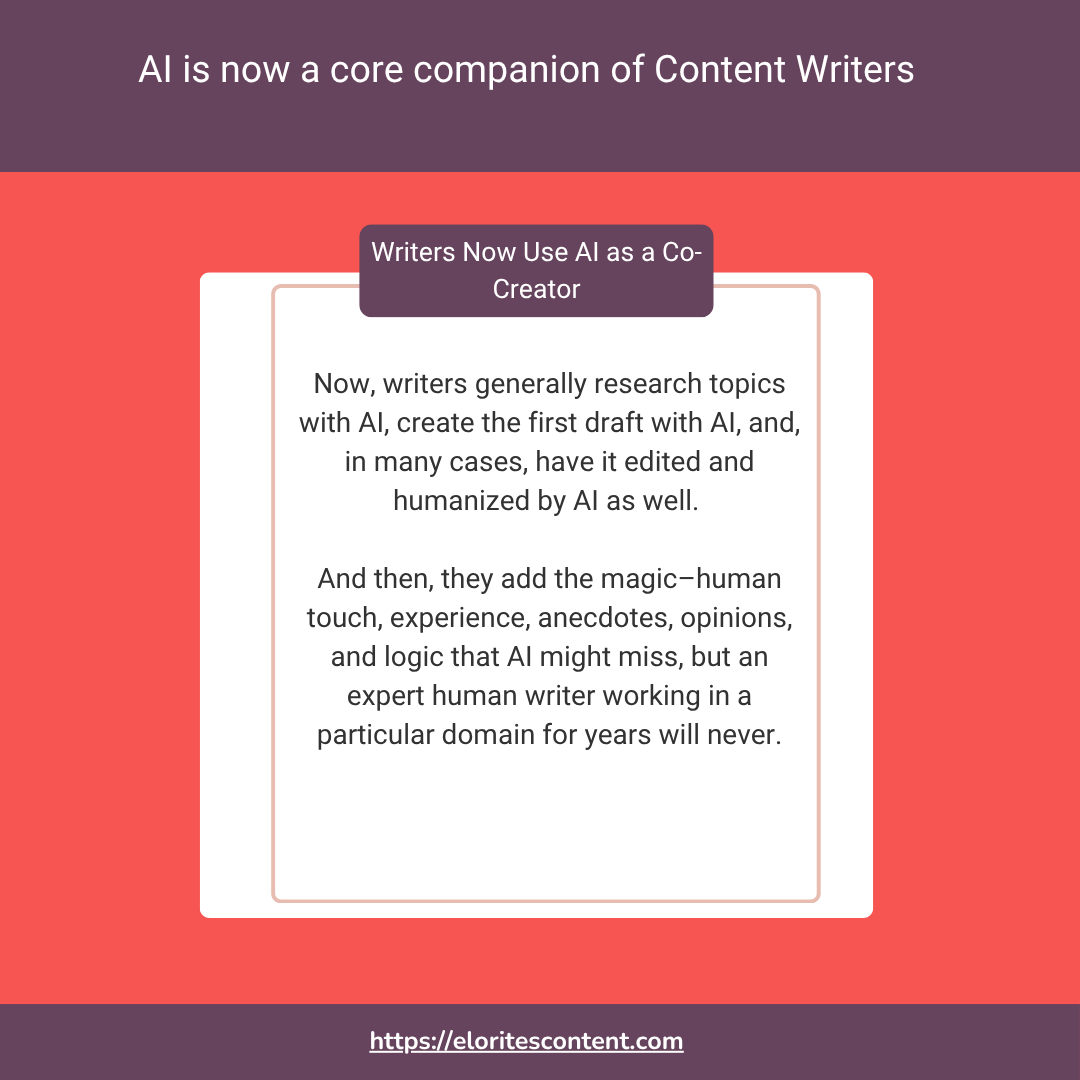
Writers now often use AI to research topics, draft content, and polish their work. They then add their expertise, domain knowledge, terminologies, experience, and unique insights that breathe life into every piece. It adds the depth and the perspective that AI often misses.
Therefore, the content writing industry (worth nearly US$25 billion) remains extremely lucrative.
Why?
Because AI cannot replace content writers entirely.
AI is still a companion, an assistant, and a tool that does most of the tough work and improves writing efficiency.
#2 Verification of AI Content Done by Human Writers Only
Also, to verify the AI output, all businesses employ content writers.
| All Gen AI tools still come with a disclaimer: ” The tool is an AI. It can make mistakes”. |
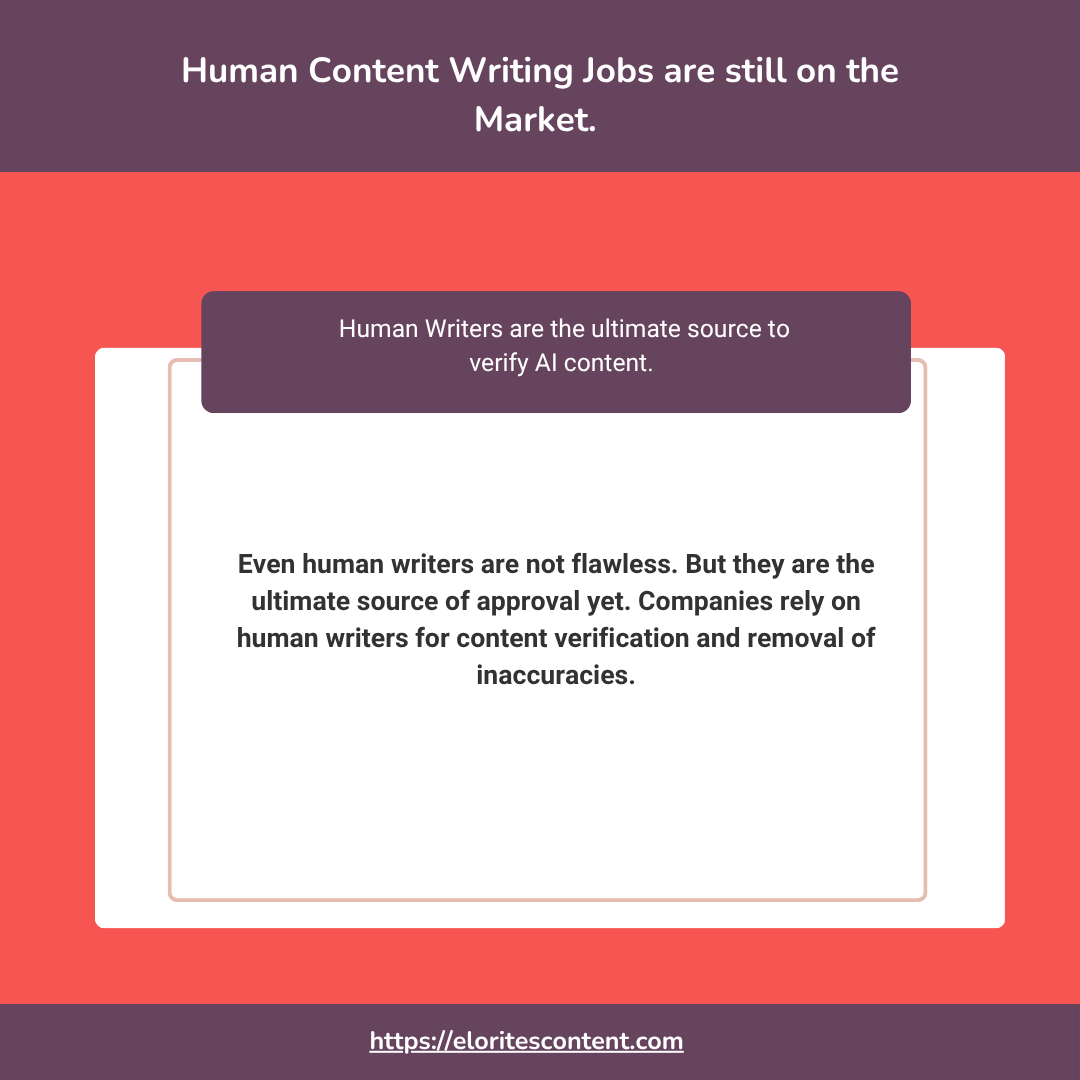
Even human writers make mistakes. But still, they are the ultimate source of approval. They are employed to detect AI hallucinations, errors, incorrect citations, and incorrect original source linking. Egen companies that use Gen AI are not blindly generating content from AI and putting it on their websites.
They rely on human writers for verification, content control, removal of inaccuracies, refinement to add a human touch, and maintenance of brand consistency in the content.
This is why human content writing jobs are still on the market.
#3 Plenty of Content Writing Jobs are Still Listed on Job Marketplaces
See the screenshots below of a Google search query: ‘Content Writing Jobs in the USA’.
Indeed.com shows 1234 jobs, Glassdoor shows 1042 jobs, and LinkedIn shows 2000+ content writing jobs in May 2026.
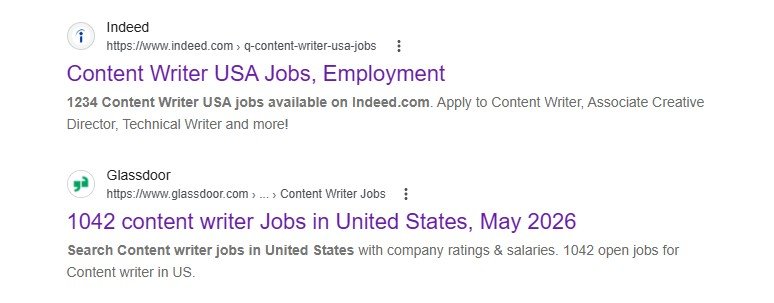

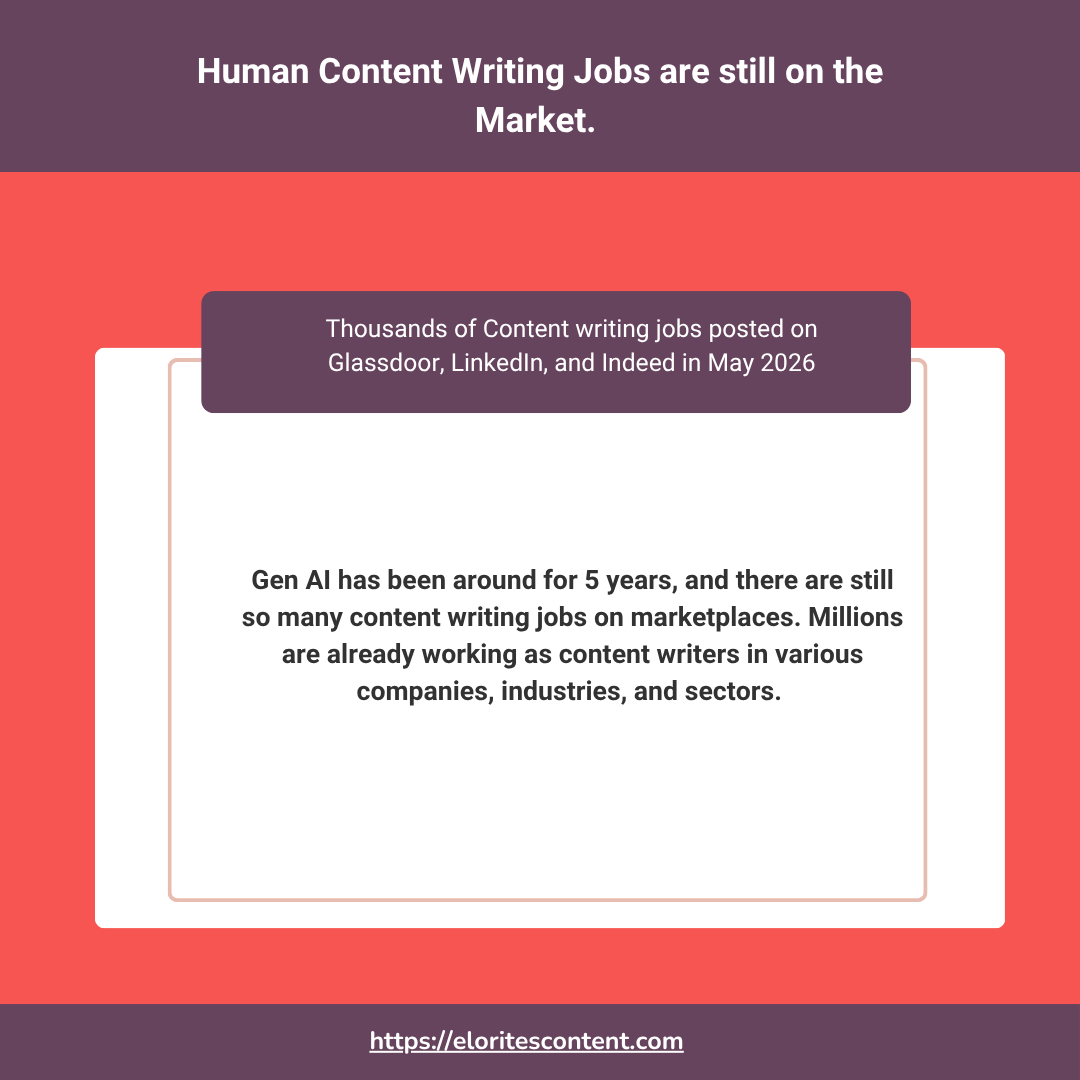
As seen in the job listing screenshot above, there are still many content writing jobs on marketplaces. The platforms and job marketplaces are posting content writer requirements every day. Also, if we search for content writing jobs on LinkedIn search, we find hundreds of hiring posts by HRs related to content writing. We can safely say that AI has not taken content writing jobs entirely in half a decade of its prominent existence. Also, millions of people worldwide work as content writers at various companies.
contentwriter.co, a global content marketing organization founded in 2019 in Poznań, Poland, cites research in a LinkedIn post, stating that more than 239 million companies use content marketing. It means there is a potential job opportunity for 200+ million content writers worldwide.
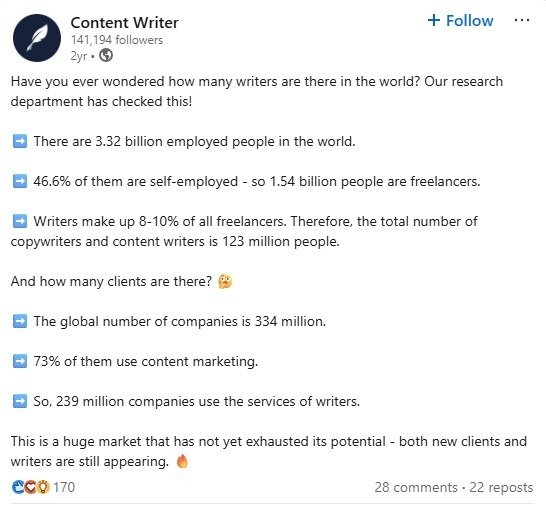
Source: LinkedIn Post by ContentWriter.co
#4 Thought Leadership and Personal Brand Content Still Done Humanly
Thought leadership and personal branding are increasingly becoming popular after 2025. As there is a boom in podcast content across platforms, every CEO/Founder knows that their audience and customers also want to hear their personal stories and experiences. This is where human content writers have significant leverage over AI.
AI can write a competent article about “How to Build a SaaS Product.” But it cannot write about how a CEO managed a crisis period (unless the info is already available online). So, first-person narratives are still a major no-AI zone.
Articles about how a CEO started a business or how their company builds a brand are something where AI cannot help. AI needs to know the context, and so you won’t find an answer directly by a prompt.
So, CEOs, Founders, and highly revered professionals in their fields, such as specialist doctors, renowned lawyers, or investors, who want to share their experience or build their personal brand on social media, look for content writers to do it for them.

AI cannot personally interview them or know about their experiences, failures, key decisions that changed their lives, or values they cherish.
Content writing for executives, founders, and subject-matter experts is one of the fastest-growing niches in content writing today.
Skilled content writers who can capture an individual’s authentic voice, key quotes, and skills and translate their expertise into compelling narratives. This is the greatest scope for content writers and also fetches them premium rates.
#5 Niche Research-Backed Content That AI Cannot Generate
Original research, proprietary surveys, data-backed reports, and industry studies are among the most cited, most linked-to, and most authoritative types of content on the internet. Survey reports in specific niches also require respondents. You cannot ask AI to create survey reports (it will create them, but it will fake the data or use synthetic data).
So, an original research report with a proper survey is still a content writer’s forte. That’s why McKinsey, Deloitte, Statista, etc. are the most-quoted and most-referenced websites.
Or Ahrefs or Search Engine Land’s original research will be most referenced for articles related to SEO or Google algorithm changes. These articles are based on surveys or their proprietary data. AI cannot access proprietary data because it is not available on the web.
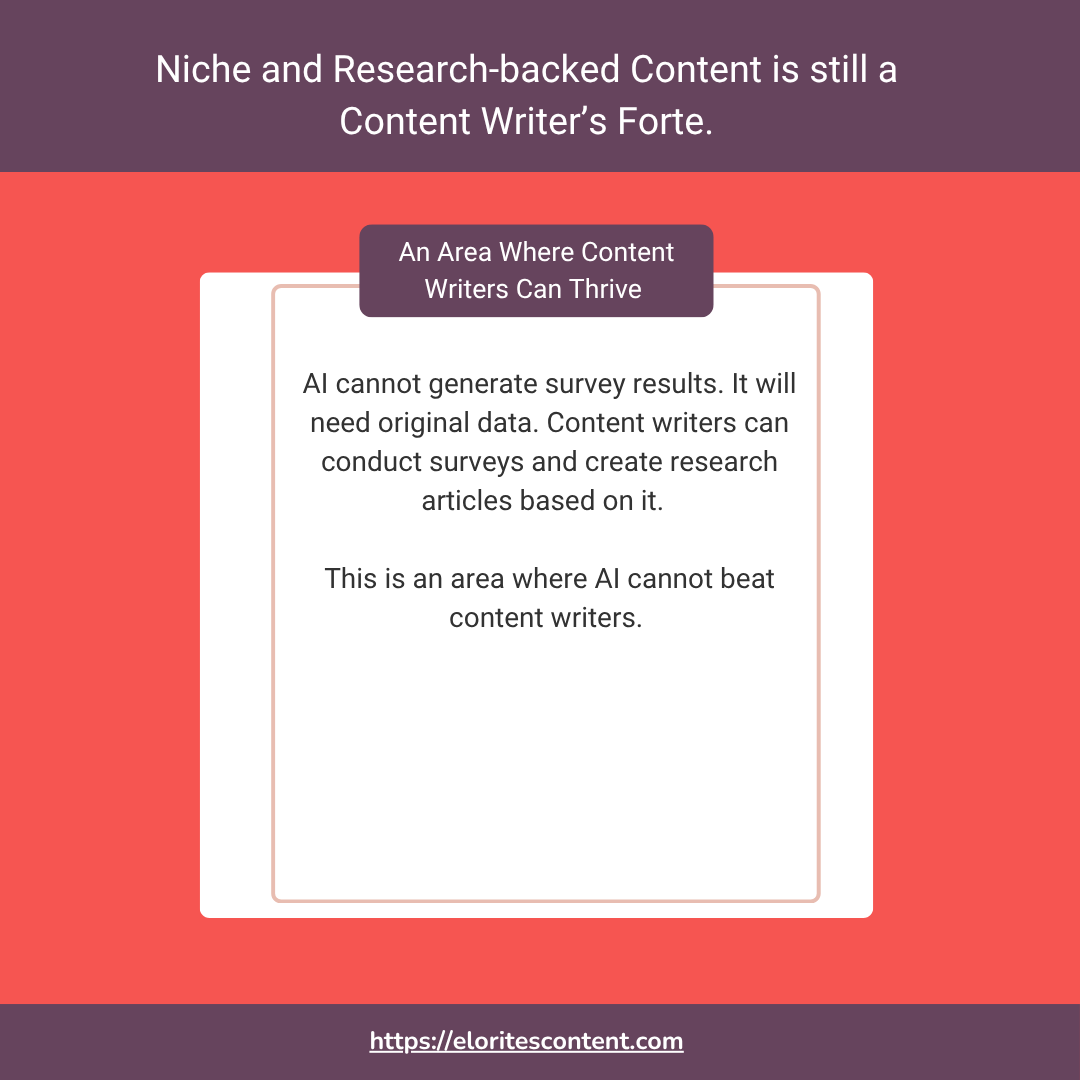
Content agencies and writers who conduct original research on the client’s behalf have a scope of survival.
#6 Scope for Content Strategy and GEO/AEO/SEO Consulting
The era of the “content writer who just writes” is giving way to the era of the “content strategist who also writes.” Brands know they cannot simply provide prompts and generate content for their websites that is AEO/SEO/GEO-optimized.
Also, how to make content GEO-friendly (from user intent to algorithms) is something brands know little about.
These companies are unaware of how content+SEO domain expertise is required to make content optimized for answer engines or AI overviews. This is where human content writers skilled in creating content optimized for generative engines, answer engines, and AI overviews will be in great demand. Content writers can position themselves for this gap. (Source: Search Engine Journal — 16 Content Writing Tips From Experts To Survive 2026)
Current Challenges in Content Writing are Temporary
In our latest research on the impact of AI on the content writing industry, we found many challenges writers are facing, but we believe these are temporary and will be resolved over time.
For instance, 72% of respondents (content writing agencies and freelancers) reported in the survey that onboarding clients has become difficult because clients subject their content to heavy scrutiny using AI detectors. However, these are temporary challenges that will subside once the AI vs. human content debate (which is hot right now) is over.
Soon, both AI and humans will be part and parcel of the content writing industry, and clients will be more accommodating of its usage and prevalence.
Happy News for Content Writers: Original Content is still the Source for AI Overviews
(Content writers are worried about AI overviews, but it is a short-term issue, as original content is also required for AI overviews.)
Many content writers and website owners are more worried about the AI overviews than AI taking their jobs. Search queries ending with zero clicks are currently causing panic among many. AI overviews decreasing web traffic for informational queries is more worrisome than AI taking content writing jobs (which I am sure is never going to be the case).
While most of the content writing industry has been busy debating AI vs. human writers, a more dangerous shift started with the rise of zero-click searches. These are searches that end on Google’s Search Engine Results Page (SERP) itself, without the user ever clicking through to any website.
For instance, you search for “best time to post on LinkedIn,” and Google’s AI Overview gives you a neat answer right at the top. You got your answer. You move on.
The content writer who spent hours creating the 2,000-word data-backed article on the same topic?
Their website never saw you.
Searches that trigger AI Overviews now show an average zero-click rate of 83%, compared to around 60% for traditional queries without AI Overviews. In other words, 8 out of 10 users searching with an AI-powered query never leave Google’s interface. (Source: Click-Vision Zero-Click Search Statistics 2026)
The hardest-hit content categories are the ones content writers have traditionally thrived in: informational articles, how-to guides, tutorials, and explainers. According to Ahrefs, AI clicks reduce website traffic by 34.5%. Virtually all informational keywords now trigger an AI Overview. Some sectors have lost 40–70% of their organic traffic in a single year. Wikipedia is reportedly losing 8% of its traffic year-on-year due to AI Overviews.
But our Director, Jayesh Mehta, has a different view. He quotes:
“AI overview is a short-term problem for the content industry. The future of content writing depends on how content writers and content writing agencies are able to show resilience to AI overview-led zero-click searches. All current AI overviews will also need new content for revamping their answers or updating the outdated content. And this is where content writers have the opportunity. They are always the primary content creators and will remain so.
AI-Overview-led zero-click searches are creating only short-term web traffic issues.
AI overviews are not a threat to content writing as a profession. Ironically, AI Overviews’ very existence depends on content writers continuing to produce original content.
Let me explain:
The content that gets cited inside Google’s AI Overviews still has to come from somewhere, and that somewhere is well-researched, authoritative, human-written (or human-verified) content.
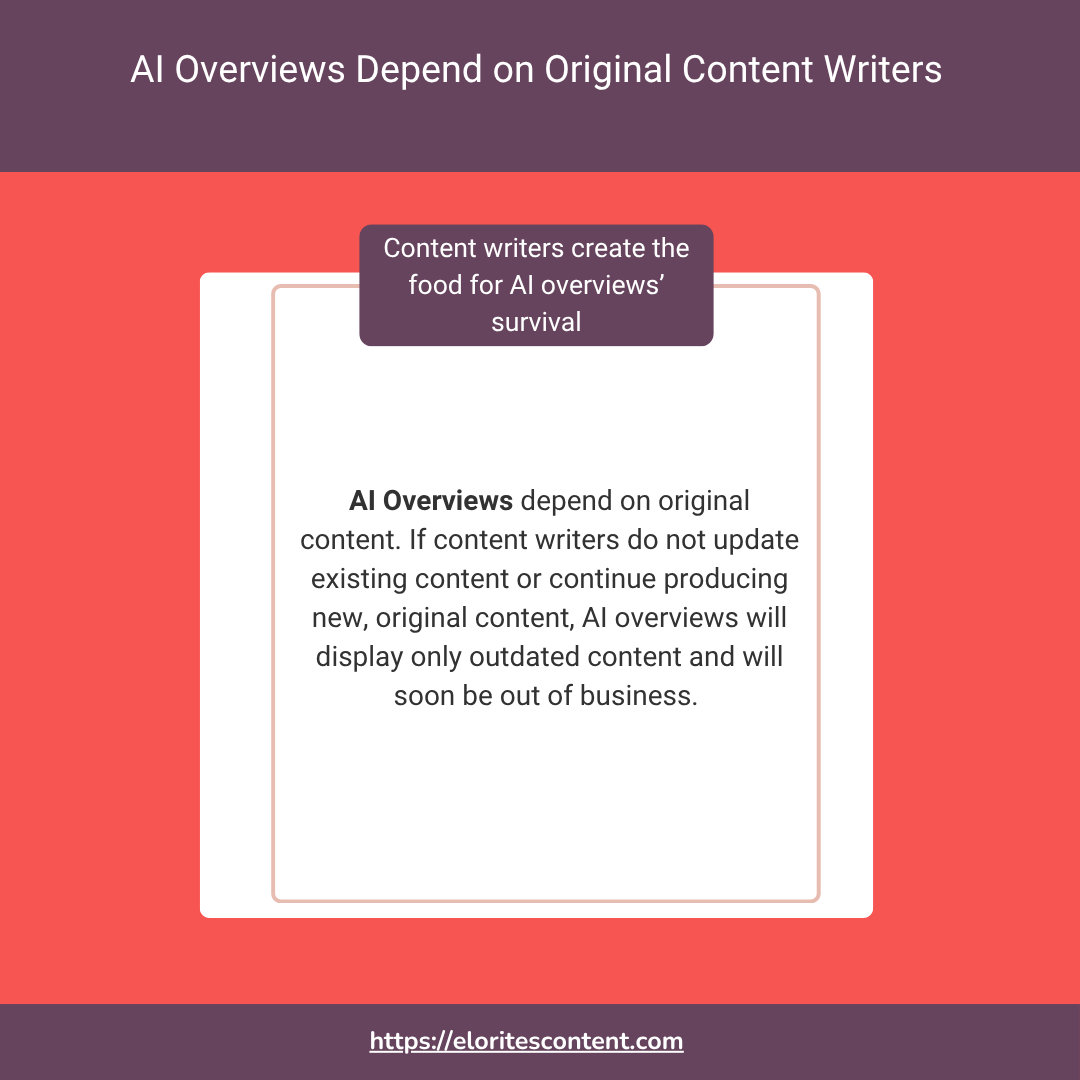
For instance, if someone doesn’t write about content writing trends of 2027, AI overviews will not be able to show any content for the same. Or it will show only the old one. Google’s AI does not create original content. It cites, summarizes, and aggregates it. The brands and content writers who understand this distinction will thrive.
While Zero-click searches will continue to reshape how content is consumed, and AI Overviews will continue to absorb informational traffic, content writers have the responsibility to create the ‘original, ‘helpful, and ‘domain-specific’ content on which these AI overviews survive.
No one cites AI Overviews: People Need Original Source Link References:
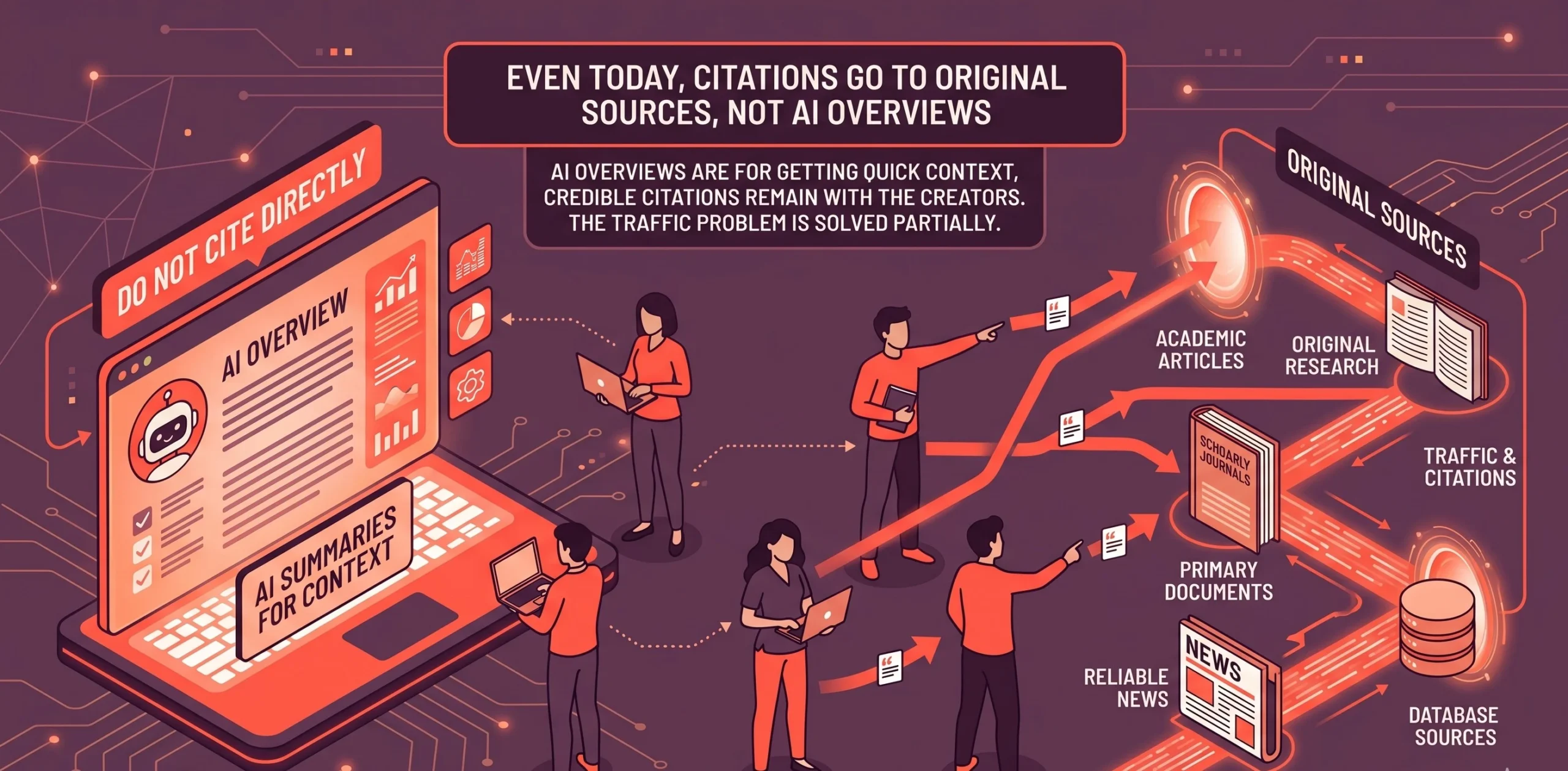
No one cites an AI overview in their content; they go to original sources for citations. So, somewhere or the other, the traffic problem will be solved partially. Even AI overviews provide the reference links themselves. So, the original content creators are referenced, and there’s a chance users will click them for reference.
Wrapping Up
The opportunities in 2026 are not fewer than they were in 2019. They are just different. And for writers willing to adapt, they are arguably better. The content writing industry is not entering a dark age. It is entering an age of differentiation. The companies that once considered replacing their content teams with AI tools have largely returned to human-based writing. They allow AI to produce, but depend on human writers to optimize and humanize the output. So, writers, trust your instincts and keep going. Also, there is a rise in video content for digital marketing. This new avenue opens up opportunities for video script writers.
The future of content writers and the content writing industry remains lucrative. Period.
Author Bio:
Nirupa Mehta
Nirupa Mehta is a content manager at Elorites Content. She is a seasoned Content Writer and SEO strategist with over 7 years of experience in developing and executing SEO strategies. She is also a former SEO coach. As the content manager at Elorites Content Private Limited, she plays a critical role in handling client projects.